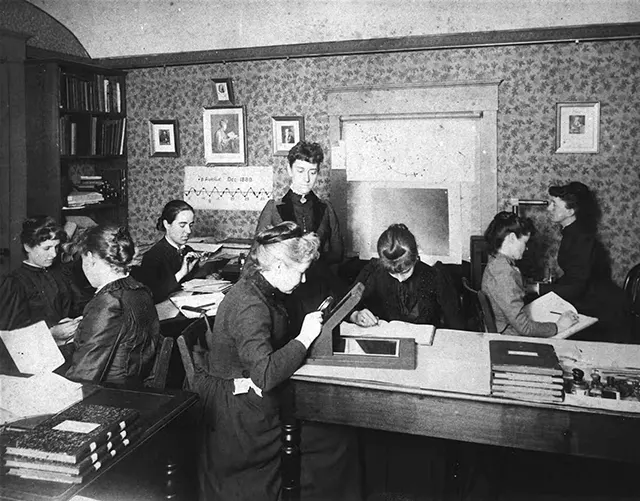
Quiet concentration fills a patterned-wallpaper room as a team of women—Harvard’s “computers”—work shoulder to shoulder around a long table, heads bent over ledgers, forms, and reference books. Pens, stacked volumes, and small instruments crowd the workspace, while a large diagram on the wall hints at the kinds of calculations that turned observation into usable scientific knowledge. The scene feels domestic at a glance, yet every detail points to disciplined, professional labor.
In the late nineteenth century, “computer” meant a person who computed, and Harvard’s women calculators became essential to the era’s expanding ambitions in measurement and data. Their days were spent checking figures, reducing observations, and standardizing results—careful, repetitive tasks that demanded precision and patience. The photo’s mix of open books, neatly arranged paper, and shared working space reflects a collaborative system built to process more information than any single scholar could handle alone.
Harvard Computers at work, circa 1890, offers a vivid window into the hidden infrastructure of science before electronic machines took over the word. It’s also a reminder that innovation isn’t only found in new devices; it can be seen in the methods, routines, and teams that made large-scale research possible. For readers interested in women in STEM, the history of computing, and Harvard’s scientific past, this image brings the human side of “inventions” into sharp focus.