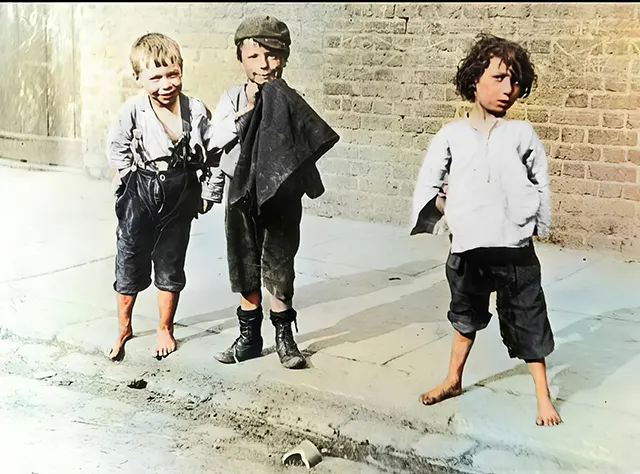
Bare feet and rolled-up trousers set the tone immediately: three London children stand on a dusty street, their clothing mismatched and well-worn, posed against a plain brick wall. One boy smiles openly despite the grime and rumpled shirt, while the others carry a guarded, tired composure that hints at harder days. The colorization brings out the stark contrast between pale fabric, dark caps and jackets, and the sunlit ground at their feet.
Street scenes like this sit at the heart of late-Victorian London’s social history, where poverty and childhood ran uncomfortably close together in the public eye. The simple backdrop—brickwork, pavement, and open space—suggests a neighborhood where play, work, and survival often happened in the same few yards. Even without a named street, the small details speak loudly: patched garments, improvised layers, and the practical choice to go without shoes.
For readers searching for “Slum children of London, 1895,” this restored photo offers more than a glimpse of faces; it invites questions about housing, wages, schooling, and the fragile safety nets of the era. Colorization doesn’t soften the story so much as sharpen it, turning a distant moment into something immediate and human. Spend a moment with their expressions and posture, and the statistics of Victorian poverty become three individuals standing in the light.