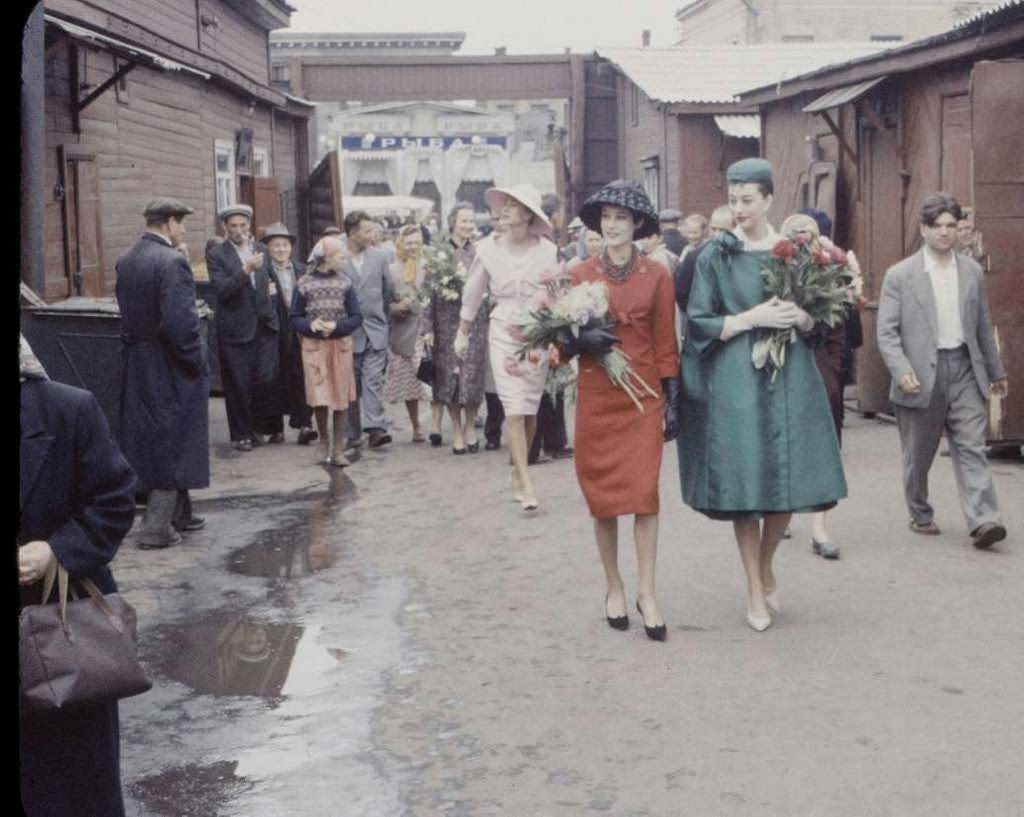
Down a muddy Moscow lane bordered by wooden buildings, a small crowd gathers as impeccably dressed women glide forward with bouquets in hand. Their tailored coats, sculpted hats, and careful posture read like Parisian runway language translated onto Soviet pavement, turning an everyday street into an unexpected stage. Faces in the background lean in with curiosity, as if the cut of a sleeve or the swing of a hem might reveal something larger than fashion.
The title’s “1959 fashion shock” makes sense in moments like this, when Dior-style elegance meets the practical rhythms of the USSR. The contrast is the point: glossy silhouettes and refined accessories against workaday coats, flat caps, and puddles that reflect the scene like a rough mirror. Even without a named boulevard or official banner in view, the photograph suggests a cultural encounter—Western couture arriving not as an abstract idea, but as a living, walking spectacle.
For readers interested in Cold War culture, Soviet street style, and the history of haute couture, this image offers a vivid entryway into how fashion traveled across ideological borders. It hints at soft power in stitches and seams, and at the public’s hunger to look, compare, and imagine different possibilities. “When Dior Took Over the Soviet Streets” isn’t just about clothing; it’s about the moment when aesthetics briefly reordered the ordinary, right there in the street.