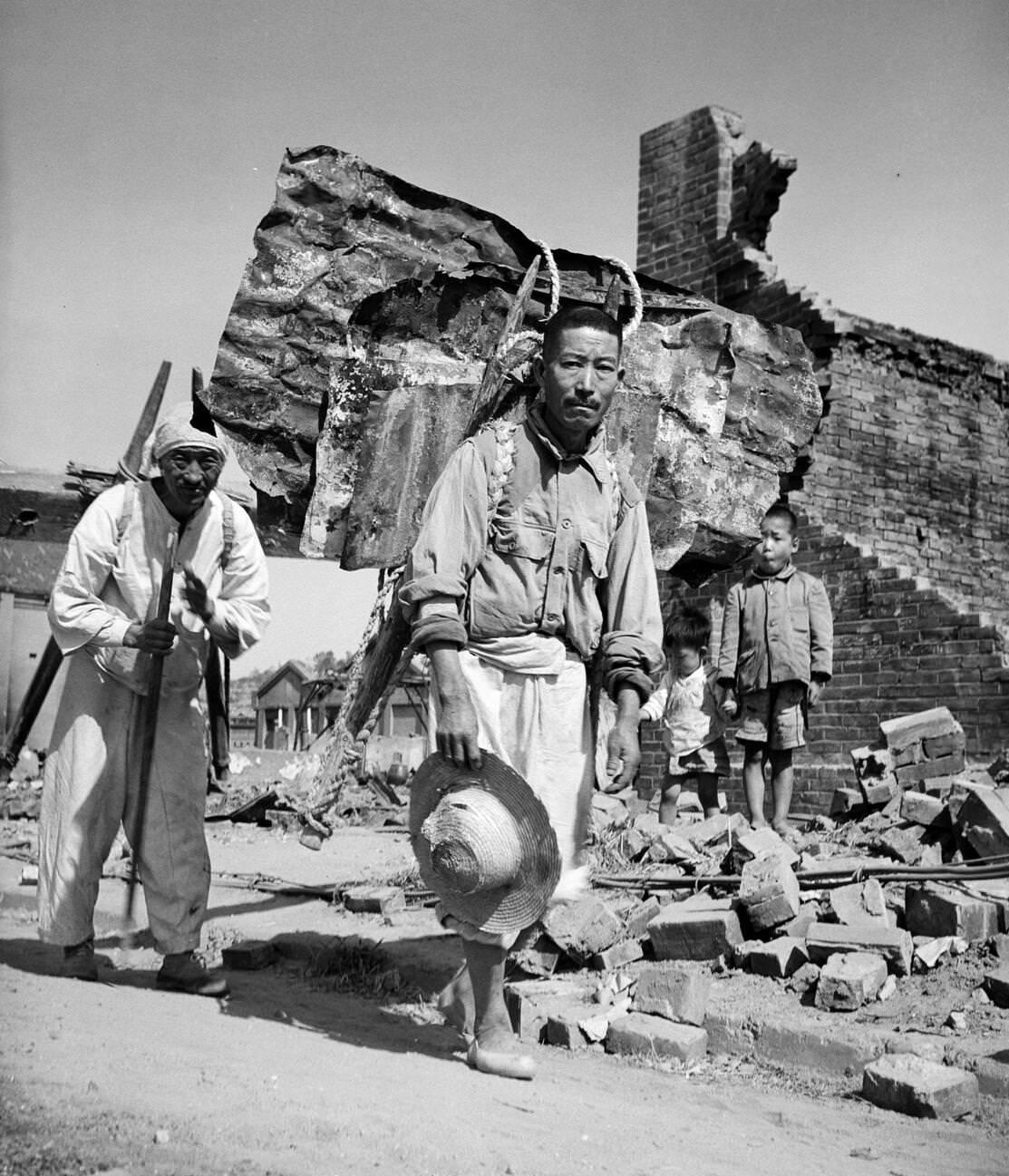
In the shattered streets of Inchon during the Korean War, recovery began with whatever could be lifted, carried, and reused. A man steps forward under a precarious load of corrugated metal strapped to his back, his straw hat hanging from one hand like a small reminder of ordinary life. Behind him, broken brick and collapsed walls form a jagged landscape where survival and reconstruction blur into the same daily task.
Nearby, another civilian steadies himself with a long pole as he navigates the rubble, while children linger at the edge of the scene, watching the adults work. The remains of a chimney and a partially standing brick structure suggest how abruptly homes and neighborhoods were torn apart. Nothing here is wasted; every sheet, beam, and brick becomes a possible roof, a repaired doorway, or fuel for a stove.
Photos like this anchor Korean War history in the lived reality of civilians, far from battlefield maps and official communiqués. Salvaging building materials from ruins was both necessity and quiet defiance—a way to reclaim a future from destruction one piece at a time. For readers searching Inchon 1950s images, Korean War civilian life, or wartime reconstruction, the scene offers an unvarnished glimpse of resilience amid the aftermath.