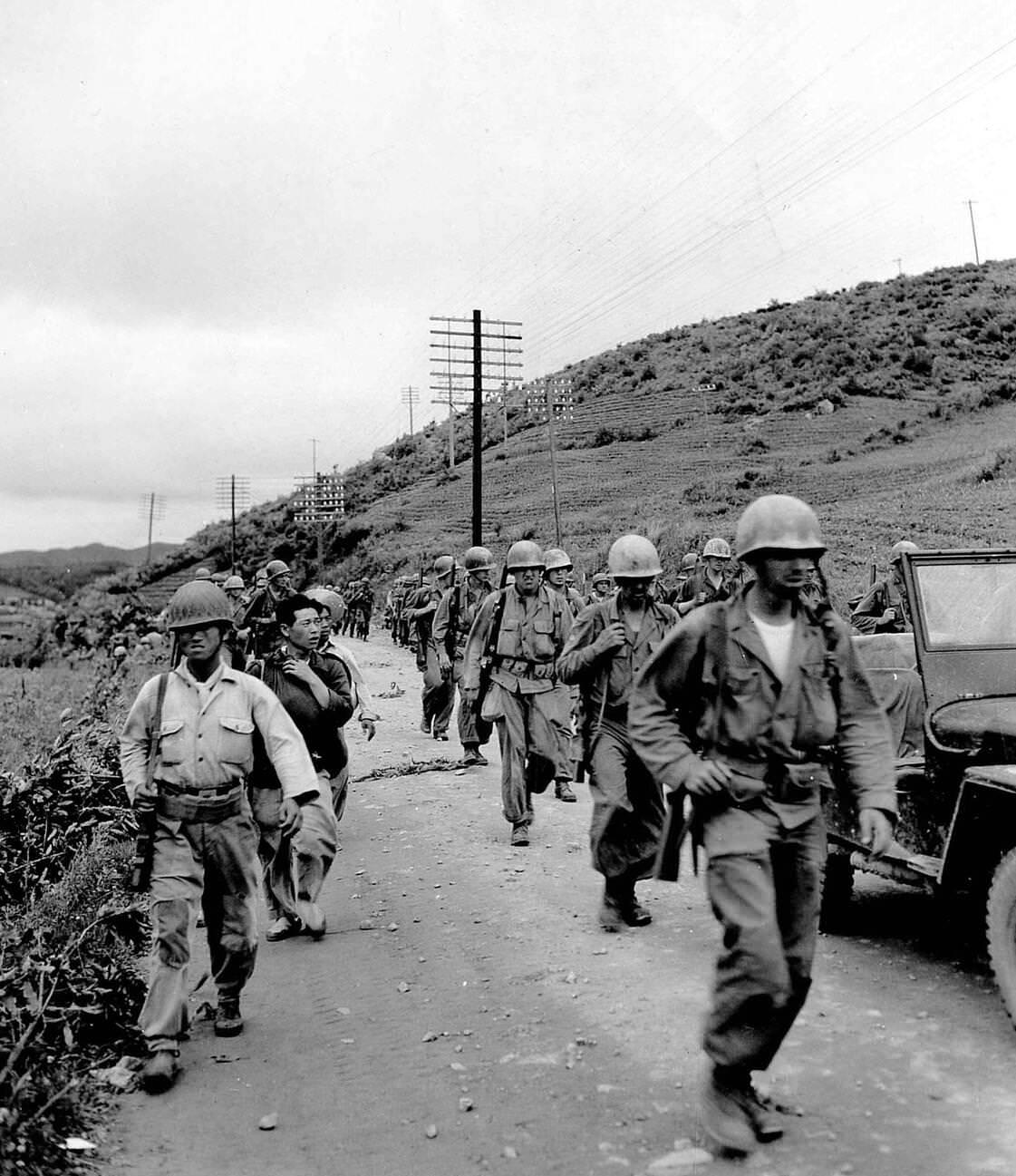
Along a dusty road in the Kum River area, a column of helmeted infantry moves forward in the open, stretched out beneath a line of telephone poles that recede into the hills. The title places these men with the 21st Infantry Regiment during the Korean War in 1950, and the scene feels like a moment between engagements—marching order, gear cinched tight, eyes scanning ahead. A jeep edges the frame, hinting at the constant mix of foot movement and motor transport that shaped operations in Korea’s rugged countryside.
The terrain tells as much of the story as the soldiers do: a broad slope rises on the right, patched with brush and scrub, while the road cuts a narrow corridor through an exposed landscape. The long files emphasize scale and strain, suggesting a unit on the move rather than posed for the camera, with dust and uneven ground underfoot. For readers searching Korean War photos, this image offers a grounded look at the everyday mechanics of campaigning—distance, weather, and roads as unforgiving as any enemy.
What lingers is the human rhythm of the march, where individual figures blur into a disciplined flow, each burdened with weapons, packs, and the immediate demands of survival. Photographs like this are invaluable for understanding the Korean War beyond maps and headlines, capturing how a regiment advanced through contested river country one step at a time. In the Kum River area, 1950 becomes tangible here: not as a single dramatic event, but as the accumulation of miles walked and orders carried out on an ordinary road.