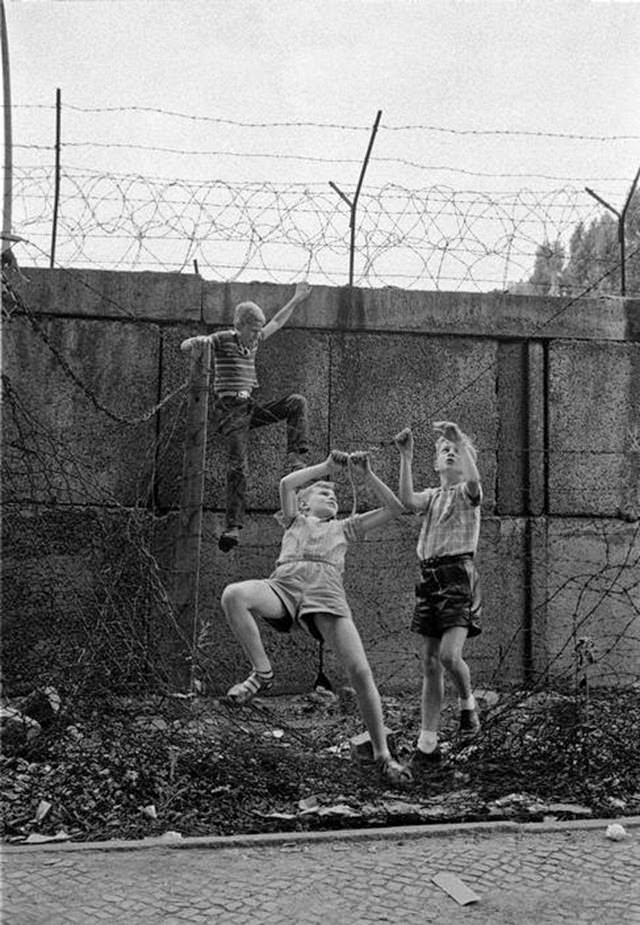
Along Bernauer Strasse, the Berlin Wall rises in stark concrete slabs, crowned with coils of barbed wire that turn an ordinary street edge into a hard border. In the foreground, three boys treat that boundary like a playground challenge: one is already perched near the top, while the others reach up, hands linked, testing footholds and balance. Rubble, weeds, and broken ground frame the scene, underscoring how quickly a neighborhood can be reshaped by political division.
What makes the moment so unsettling—and so human—is the contrast between childhood improvisation and the architecture of control. Their short sleeves and casual posture read as everyday life, yet the wire above them announces danger and surveillance. The Wall was built to regulate movement and enforce separation, but here it becomes a surface to climb, a ledge to traverse, a place where curiosity and bravado push against imposed limits.
As a historical photo of the Berlin Wall near Bernauer Strasse, this image offers more than a document of Cold War infrastructure; it hints at the lived experience around it, especially for families and children growing up in its shadow. The boys’ hand-in-hand coordination feels like a small act of solidarity, a reminder that borders are felt most acutely in the routines of ordinary streets. For readers searching Berlin Wall history, Bernauer Strasse stories, or everyday life in divided Berlin, this frame captures how the era’s tension could sit beside play in the same breath.