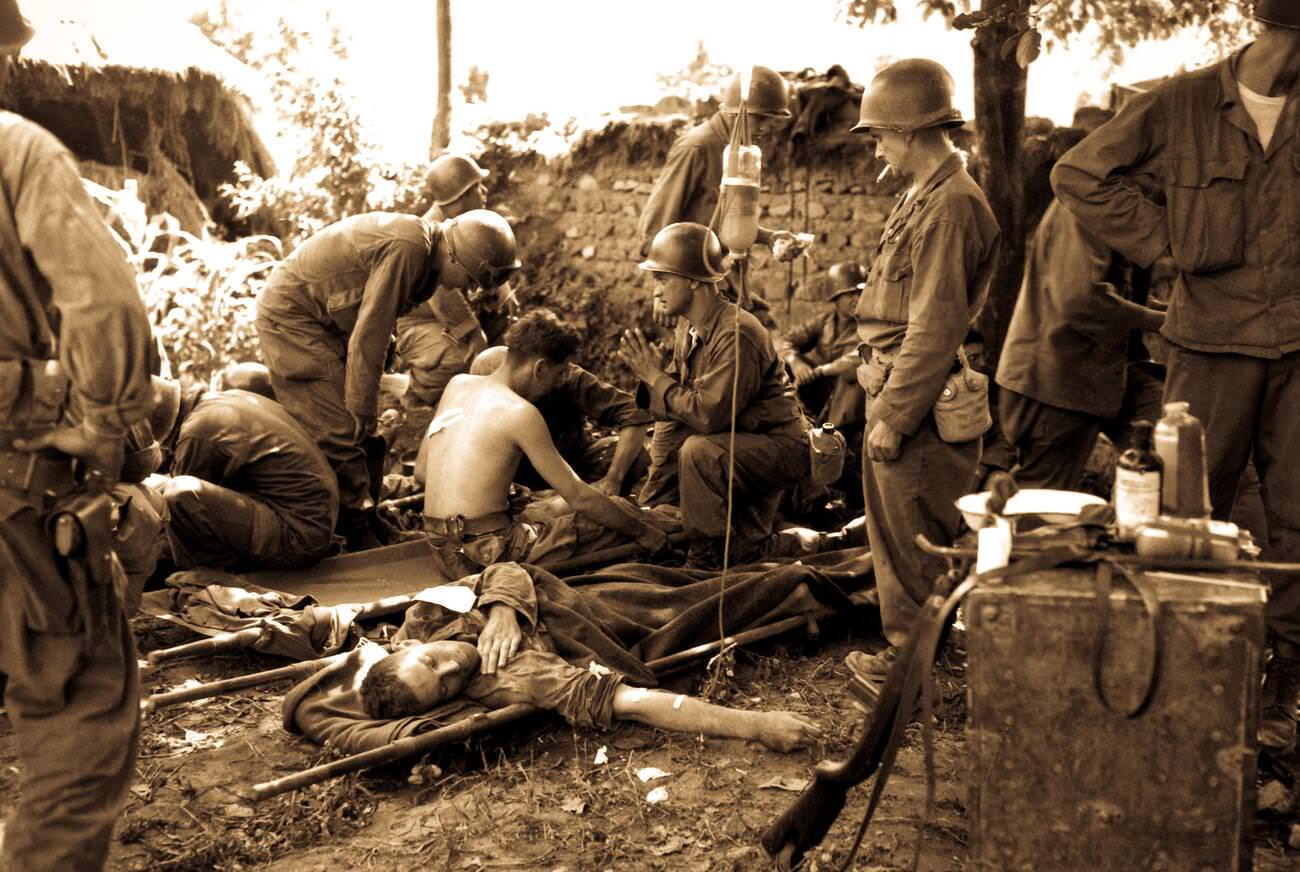
Under a rough canopy of leaves and a low wall of masonry, American soldiers cluster around a makeshift first aid station, the 1950s battlefield pushed just beyond the frame. A wounded man lies on a stretcher in the foreground while others wait their turn, some seated, some crouched, helmets still on as if the fight might resume at any moment. The scene feels improvised yet practiced—an outdoor clinic where the ground serves as floor and the shade becomes a temporary roof.
Near the center, an IV bottle hangs from an improvised support, a small, stark symbol of modern medicine carried into mud and dust. Medics and fellow soldiers lean in close, hands busy with bandages and reassurance, triage unfolding in quick, quiet decisions. Packs, canteens, and scattered supplies sit within arm’s reach, suggesting a unit that has learned to treat shock, blood loss, and pain with whatever can be assembled in minutes.
What lingers is the contrast between vulnerability and discipline: uniforms and steel helmets beside bare skin, exhaustion beside alertness, care delivered in the open air. For readers searching for Korean War–era imagery, Cold War military history, or the lived reality of combat medicine, this photo offers an unvarnished look at how first aid stations functioned when evacuation was uncertain and time was measured in breaths. It’s a reminder that survival often depended less on grand strategy than on the steady work of field medics and the comrades who carried the wounded to them.