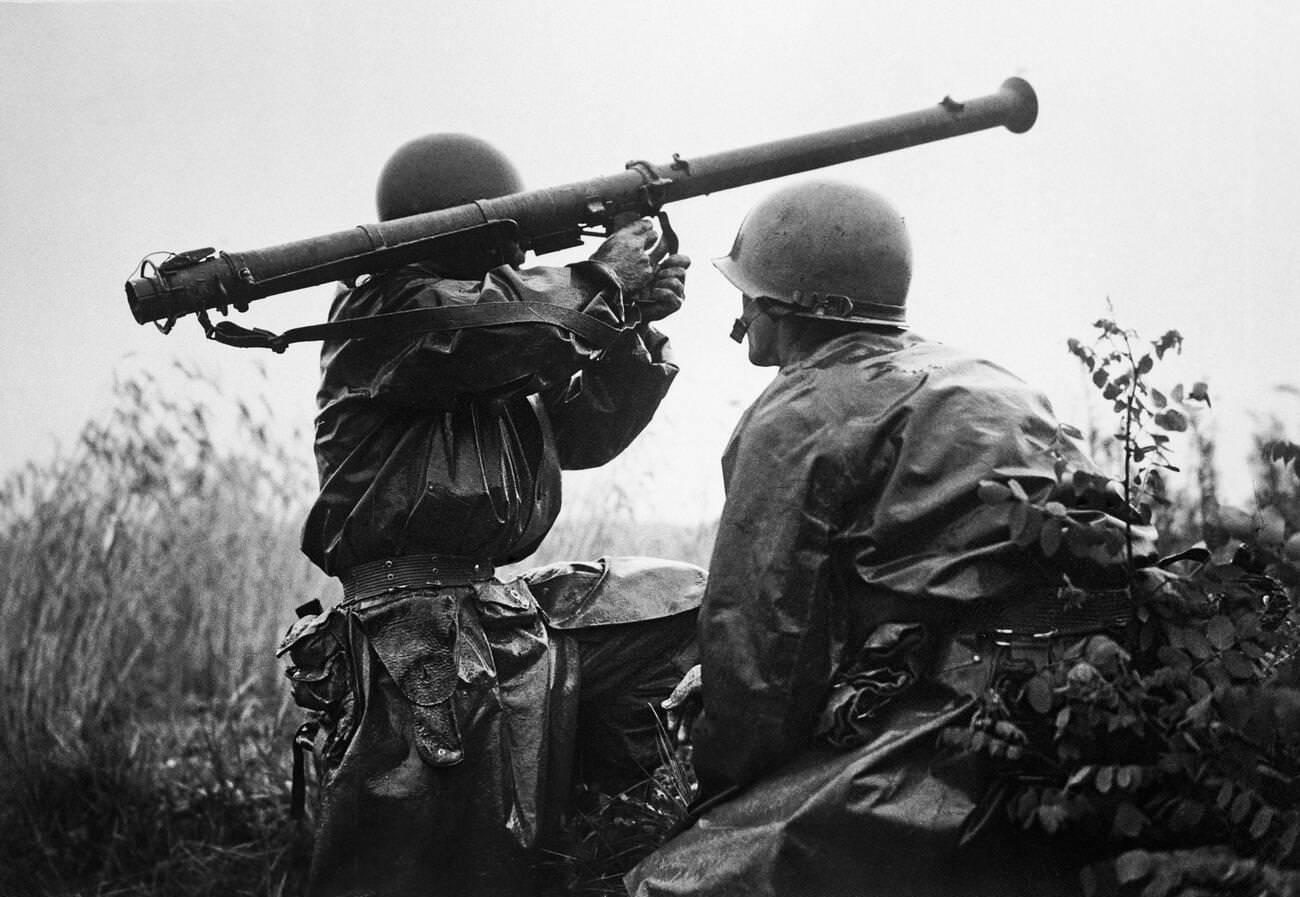
Crouched low in wet brush, two soldiers work as a tight bazooka team—one bracing the tube and sighting downrange, the other close at his shoulder in the tense pause before recoil and smoke. Their steel helmets and rain-dark jackets stand out against a pale sky, while tall grass and shrubs hint at a frontline carved into open countryside. The framing emphasizes how exposed such anti-tank crews could be, relying on cover measured in inches and seconds.
In the 1950s Korean War era, the bazooka symbolized the infantry’s urgent answer to armored thrusts, especially when North Korean tanks pressed into contested ground. The title’s reference to tanks gives the moment its stakes: a portable weapon meant to stop heavy metal at close range, demanding nerve, teamwork, and timing. Even without visible vehicles in the frame, the posture of the gunner and the assistant’s watchful position suggest a target expected at any instant.
Viewed today, the photograph reads as both battlefield documentation and a study in cooperation under pressure, capturing the human scale of anti-armor combat. Details like the slung strap, the careful angle of the launcher, and the huddled spacing between the men evoke the practical routines soldiers learned to survive. For readers searching Korean War history, bazooka teams, and 1950s combat imagery, this scene offers a stark window into how infantry prepared to meet tanks with little more than training, terrain, and resolve.