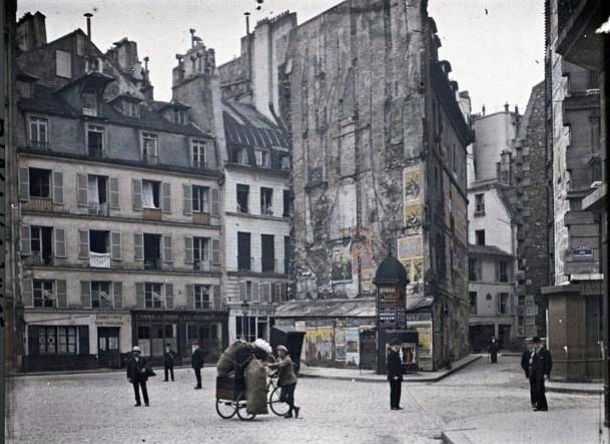
Morning light seems to wash across a small Parisian square in the 2nd arrondissement, where tall, tightly packed buildings lean toward one another in that unmistakable Haussmann-era rhythm of windows, cornices, and slate roofs. The colorization brings out subtle contrasts—pale façades, soot-darkened masonry, and the muted tones of street-level shopfronts—making the scene feel surprisingly immediate rather than distant. Above the roofs, chimneys and dormers crowd the skyline, reminding us how densely lived-in these central Paris blocks have long been.
Near the center, everyday movement animates the space: a few figures pause as if mid-errand, while a handcart or small wagon sits in the open street, hinting at deliveries and the constant circulation of goods. On the corner, a prominent wall of posters and notices turns the building into a public bulletin board, suggesting entertainment, announcements, or civic messaging competing for attention. Even without reading the text, the layered paper and weathered surface speak to a neighborhood that communicates in print and lives at street level.
Stéphane Passet’s view of Paris (II arr.) works as both cityscape and social snapshot, recording the textures of ordinary urban life—stone, plaster, signage, and people—within a compact crossroads. For readers interested in historic Paris photography, early color processes, or the evolution of the Right Bank’s central districts, this image offers a rich set of details to linger over. Look closely and the charm is in the particulars: the worn façade, the quiet spacing of pedestrians, and the sense of a city poised between routine and change.