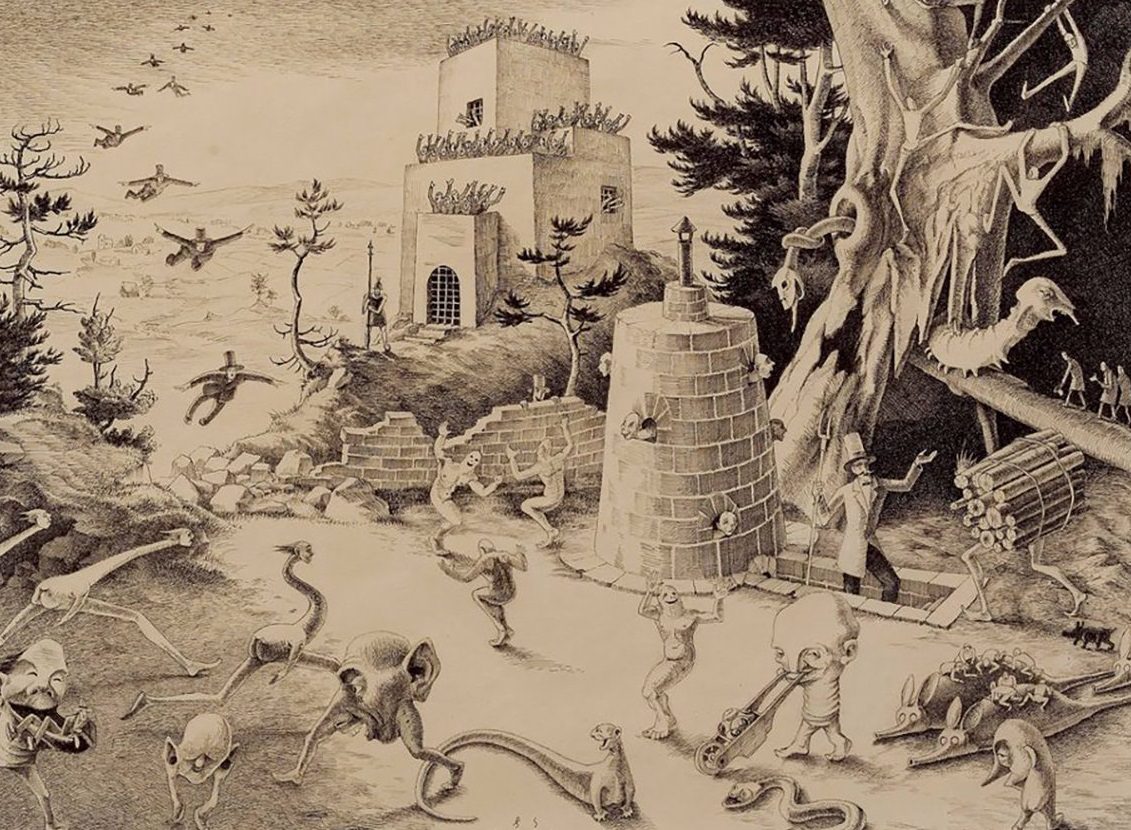
Perched on a rocky rise, a stark, blocky tower crowds the skyline while tiny figures line its terraces like a watchful chorus. Around it, the landscape slips into dream logic: birds sweep overhead, a lone sentry stands by an arched doorway, and the distant horizon feels both vast and strangely close. The title, “Fanciful Ink Drawing II, 1931,” fits the scene’s playful unease, where architecture and wilderness jostle for control.
Along the lower ground, odd creatures and impish bodies twist and tumble in a busy foreground that rewards slow looking. A long-tailed, monkey-like head seems to stride out of the earth, serpentine forms curl near the bottom edge, and small dancers or sprites gesture toward one another as if mid-performance. To the right, an immense, gnarled tree becomes its own world—home to an oversized bird and a chain-like element looping from branch to trunk—turning nature into a stage set packed with hidden vignettes.
Ink work from this era often leaned on sharp contrast and meticulous line to build atmosphere, and here the hatching and shading create a vivid sense of depth despite the impossible cast of characters. Whether read as satire, allegory, or pure invention, the composition invites comparisons to surrealist illustration and fantastical print traditions while remaining unmistakably personal. For readers searching vintage art, 1930s ink drawings, or imaginative historical artworks, this piece offers a richly detailed portal into an artist’s unrestrained visual storytelling.