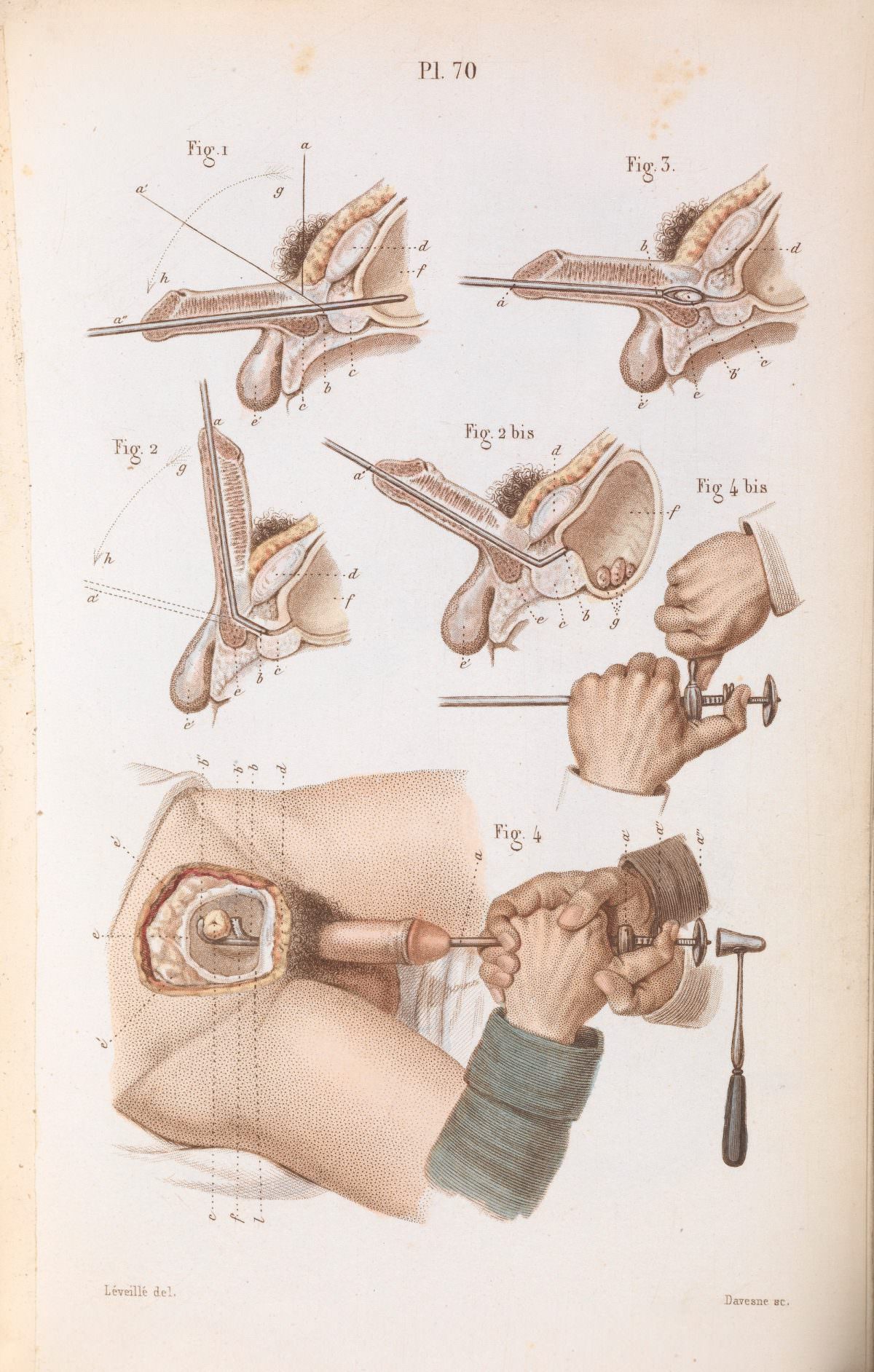
Plate 70 from *Précis iconographique de médecine opératoire et d’anatomie chirurgicale* (1848) lays out the choreography of lithotripsy—an early surgical approach to breaking and removing bladder or kidney stones—through a series of tightly labeled figures. Lettered annotations and measured arcs guide the eye, turning anatomy into a navigable map and the surgeon’s hand into a studied instrument. The soft hand-coloring, precise linework, and clinical clarity make it as much a teaching tool as a work of medical art.
Across the upper panels, cross-sectional views trace the path of slender metal devices as they enter and are positioned within the urinary tract, emphasizing angles, depth, and the relationship of tissues in the pelvis. Each vignette isolates a crucial moment: insertion, alignment, and the careful engagement of the stone, rendered with the detached exactness expected of nineteenth-century surgical atlases. Even without narrative text, the sequencing implies a procedure designed to be repeatable—knowledge meant to travel from page to practice.
Lower on the sheet, the scene widens to include the practitioner’s hands on a screw-like mechanism, suggesting the controlled force needed to crush or fragment calculi during lithotripsy. The juxtaposition of close anatomy studies with a broader operative view captures a pivotal shift in medical history, when surgery leaned increasingly on standardized instruments and visual instruction. For readers interested in vintage medical illustrations, surgical history, or the evolution of urology, this 1848 plate offers a striking window into how complex procedures were taught before modern imaging and anesthesia transformed the operating room.