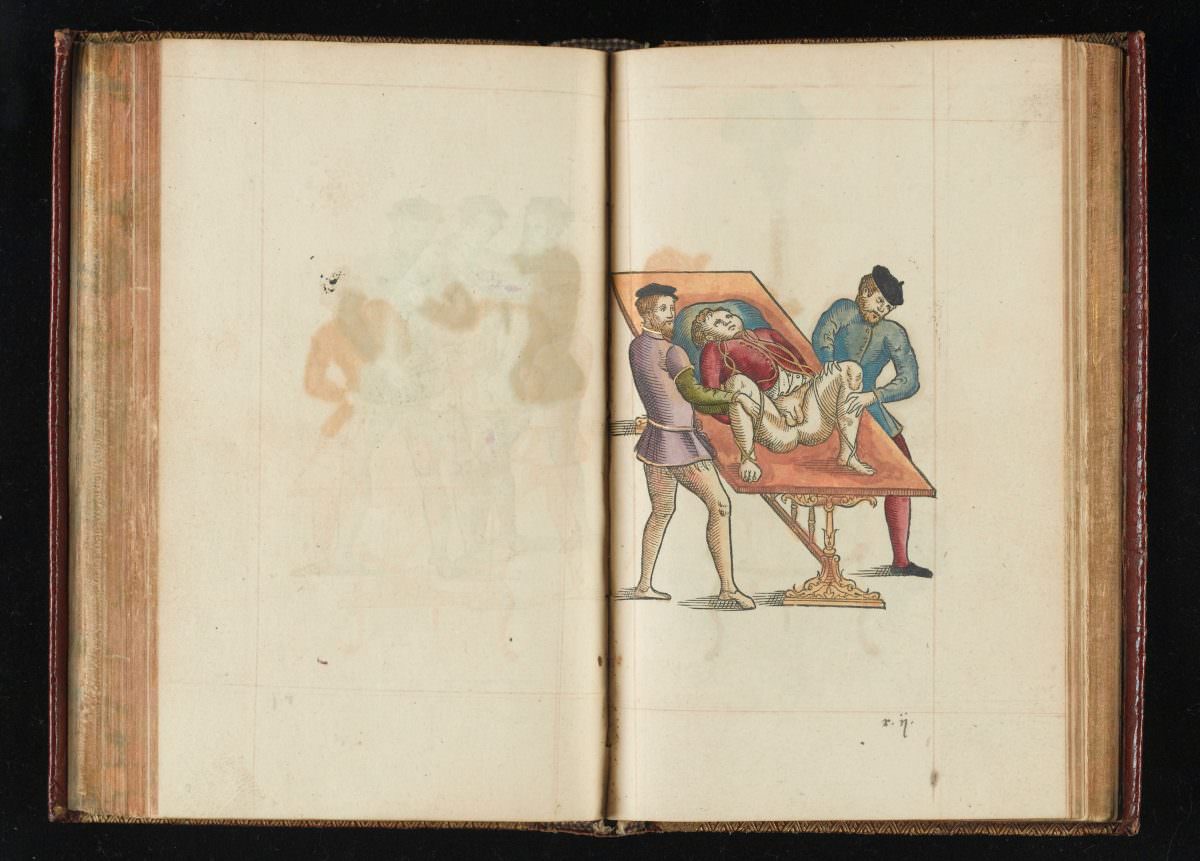
Open to the right-hand page, a hand-painted wood engraving offers a stark lesson in early surgical practice: the “necessary position” for a patient undergoing removal of bladder stones. The figure lies strapped and angled on a sturdy table, limbs arranged with deliberate precision, while two attendants brace the body for what would have been a painful, high-risk procedure. The coloring—muted reds, blues, and flesh tones—softens the scene only slightly, reminding us how medical instruction once relied on vivid, carefully tinted prints.
Every detail reads like a practical manual for the pre-anesthesia era, when immobilization and teamwork mattered as much as the surgeon’s instruments. One helper steadies the torso near the head, another controls the legs, creating the posture thought to give the operator the best access to the bladder. The spare background keeps attention on technique rather than setting, turning the patient’s ordeal into a step-by-step demonstration for readers studying surgical methods.
As a historical artwork, this engraving sits at the crossroads of medicine, printmaking, and education, preserving how knowledge circulated long before photography or modern diagrams. For anyone interested in the history of urology, bladder stone surgery, or medical illustration, the image is both clinical and unsettling—proof that healing has often demanded scenes of restraint as well as care. Its survival on the page, complete with book edges and aged paper, adds another layer of authenticity for collectors and researchers exploring antique medical art.