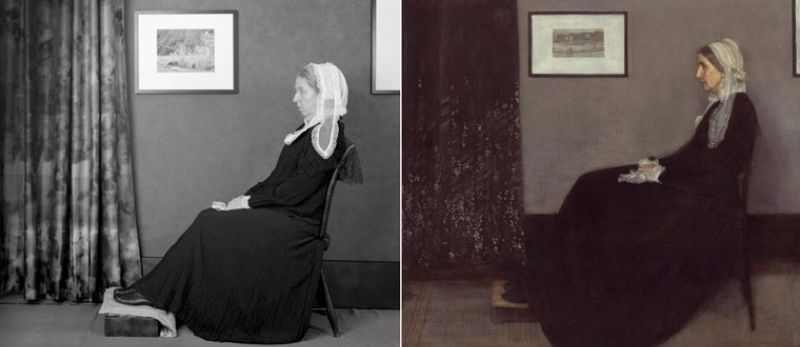
Few works of nineteenth-century art feel as instantly recognizable as James McNeill Whistler’s portrait of his mother, a quiet study in restraint and dignity. The composition is spare: a seated woman in profile, hands folded in her lap, her dark dress forming a calm, weighty silhouette against a muted wall. A simple framed print hangs behind her, while a heavy curtain at the edge of the scene adds a vertical counterpoint to the figure’s stillness.
What draws the eye isn’t dramatic action but careful balance—soft grays and deep blacks, crisp edges and gentle tonal transitions, the chair legs and floor line anchoring the sitter in a measured geometry. Her white cap and collar catch the light and lend a modest luminosity to the face, which is turned away from the viewer yet full of presence. Even the negative space feels deliberate, as if silence itself has been arranged like a harmony.
Looking closely, it becomes clear why this painting has lived so long in the public imagination: it treats domestic age and maternal authority with the seriousness of a formal monument. Whistler’s Mother is often discussed as an icon of motherhood, but it also stands as a meditation on pose, pattern, and the modern idea of portraiture—less a narrative than an atmosphere. For readers searching for Whistler’s Mother – James McNeill Whistler, this post offers a chance to linger over the subtleties that make the work enduring: its poised simplicity, its disciplined design, and its quietly commanding humanity.