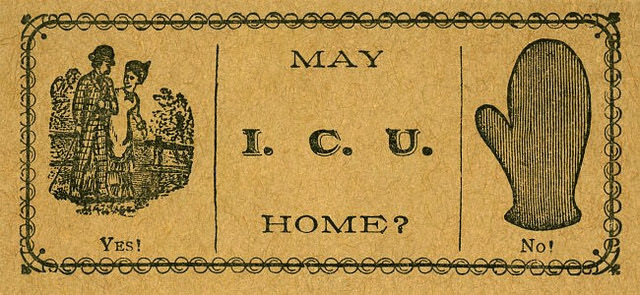
Witty wordplay sits at the center of this 19th-century “acquaintance card,” where a bold “MAY I. C. U. HOME?” stretches across the middle like a spoken line in a parlor skit. The surrounding border and tidy layout suggest something meant to be tucked into a pocket, passed along at a social gathering, and read aloud with a grin. It’s a small artifact of everyday humor—part flirtation, part joke, and wholly dependent on the reader catching the pun.
On the left, a tiny scene shows a couple in conversation, underscored by a cheerful “Yes!” that cues the desired response, while the right side counters with an oversized mitten and a blunt “No!” The mitten acts as a visual punchline, doubling as a playful rebuff and a symbol of being “given the cold hand,” echoing the title’s theme of breaking the ice. Together, text and illustration create a simple call-and-response comedy that feels surprisingly modern in its meme-like efficiency.
Social life in the Victorian era was full of rules, but items like this reveal how people still carved out spaces for fun within polite boundaries. As a piece of historical ephemera, the card offers more than a laugh—it hints at how courtship, conversation, and embarrassment were managed with props, puns, and plausible deniability. For anyone searching for 19th century humor, Victorian greeting cards, or antique flirtation ephemera, this little “I.C.U.” gag is a charming reminder that awkward introductions have always inspired creativity.