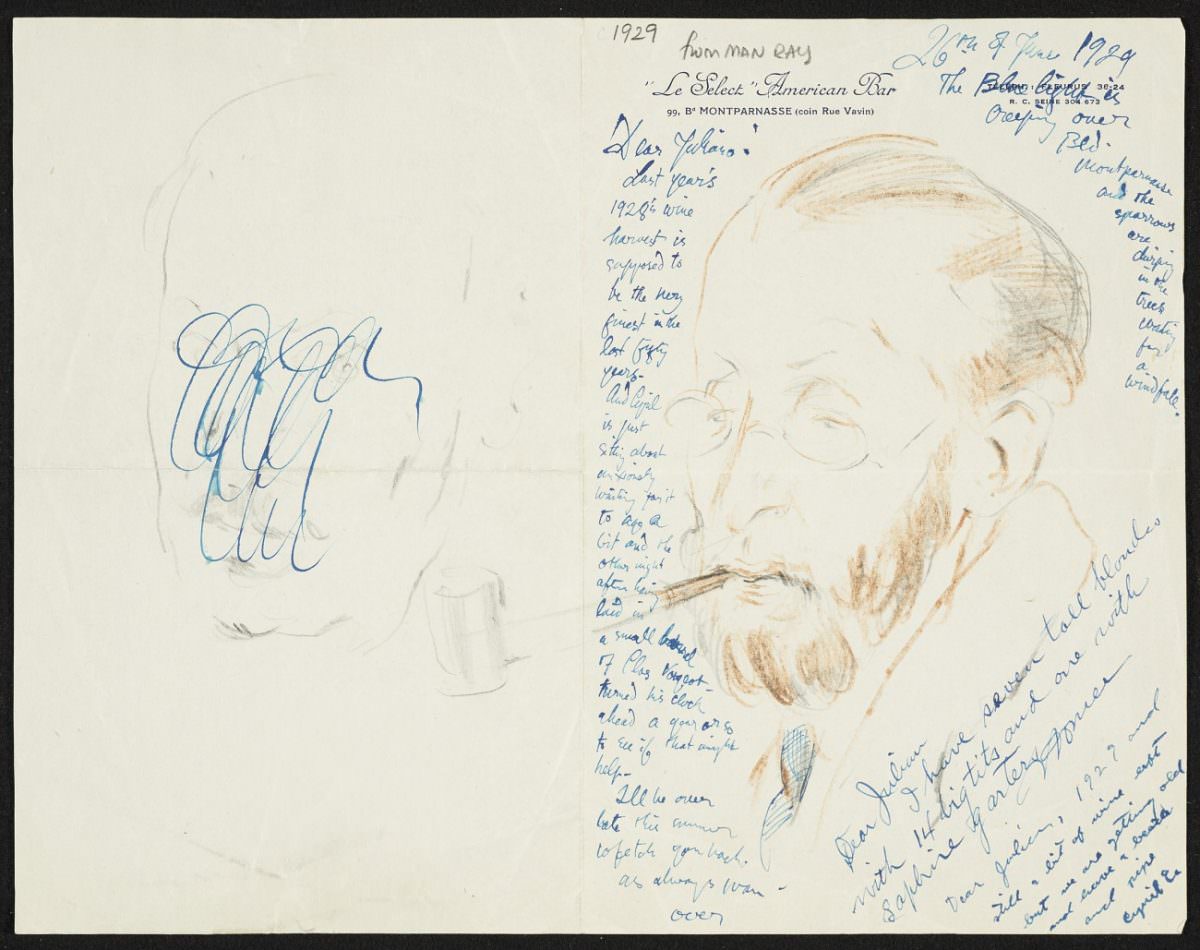
Across a creased sheet of letter paper, Man Ray’s 1929 message to painter Julian E. Levi unfolds as both correspondence and artwork, where handwriting, sketches, and a bold signature share the stage. The page carries a printed Paris heading—“Le Select” at Montparnasse—anchoring the note in the café-and-studio world that fed so much modern art. Even without needing every word to be legible, the overall effect is immediate: an intimate, lived-in document that feels handled, reread, and kept.
On the right, a quick portrait study—softly shaded with warm tones—suggests a bearded man in profile, rendered with the economy of a practiced eye. At left, lighter pencil lines hint at another figure or outline, while ink notes run vertically and diagonally, turning blank margins into a kind of visual diary. The layered marks evoke the way artists think on paper, letting drawing and writing overlap until the page becomes a single field of ideas.
Letters like this are invaluable for anyone interested in Man Ray, Julian E. Levi, and the everyday networks that sustained avant-garde culture in the late 1920s. As a historical photo of an original note, it offers texture and detail—paper folds, ink pressure, and spontaneous sketching—that reproductions often flatten. For readers searching for Man Ray correspondence, 1929 ephemera, or Montparnasse-era art history, this piece quietly bridges the gap between personal communication and modernist creation.