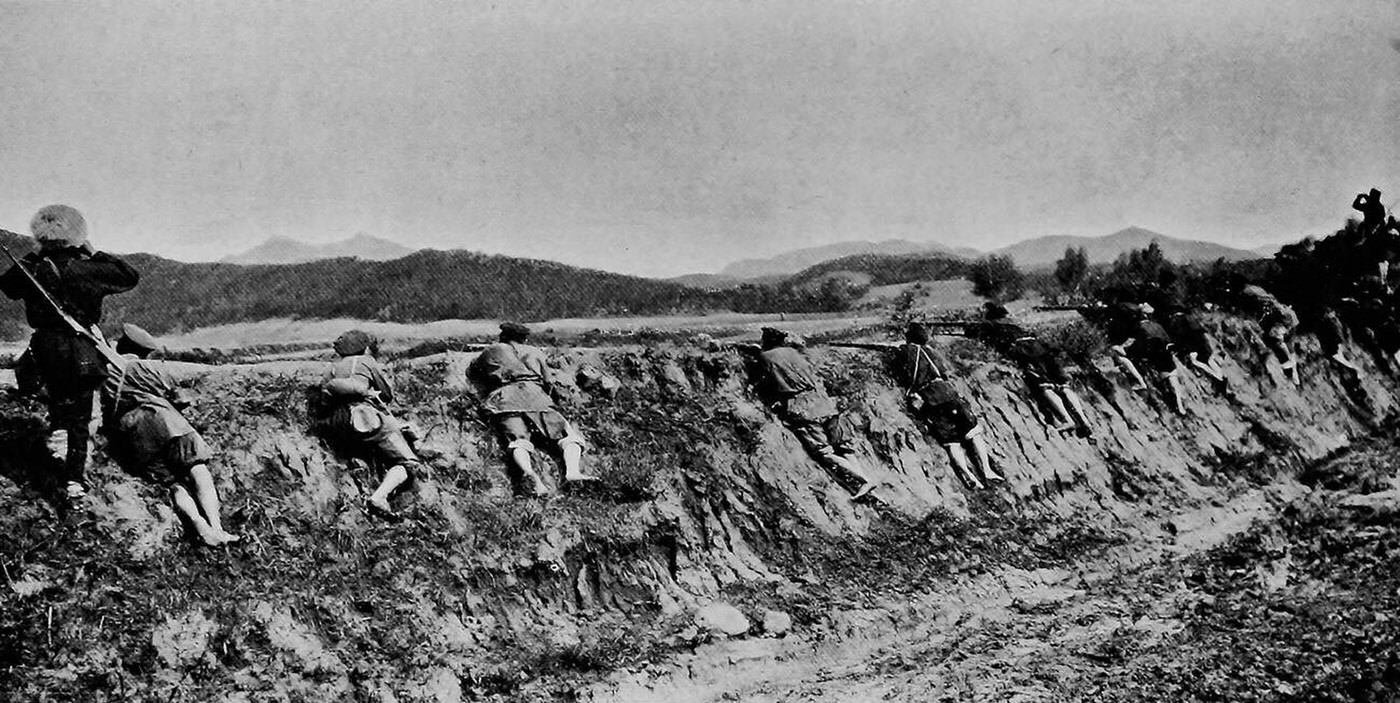
Along the lip of a rough earthwork, a line of Russian sharpshooters lies stretched out, bodies pressed into the ground as they aim across an open valley toward unseen targets. Rifles point in the same direction, and the men use the slope and sparse cover for concealment, turning a simple ridge into a fighting position. In the distance, low hills fade into a hazy horizon, emphasizing how exposed and wide the battlefield could be during the Russo-Japanese War of 1904.
What stands out is the disciplined spacing and the quiet tension of marksmanship rather than the chaos of a charge. Each soldier appears focused on observation and precise fire, a reminder that early 20th-century warfare increasingly rewarded those who could see first, shoot accurately, and stay hidden. The terrain—bare soil, shallow depressions, and a long sightline—suggests why sharpshooters and skirmishers mattered so much in this conflict.
For readers interested in wars and military history, this photograph offers a grounded look at tactics that bridged older field battles and the trench-bound methods that would soon dominate. The Russo-Japanese War is often discussed for its strategic lessons and modern technology, yet images like this bring the story back to individuals working a rifle, a position, and a strip of earth for survival. As a historical photo, it captures the practical reality of sharpshooting in action: patience, cover, and the constant search for advantage across an unforgiving landscape.