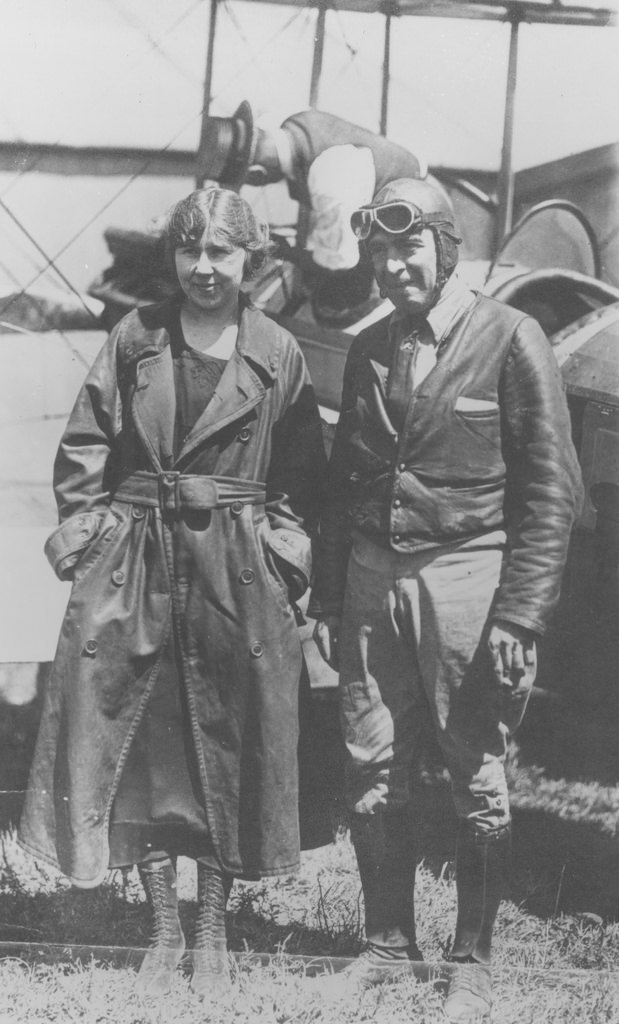
Leather coats, lace-up boots, and flight goggles set the tone in this 1920 scene of early aviation, pairing airmail pilot Eddie Gardner with reporter Muriel Kelly on August 30. They stand close to a fabric-covered biplane, its struts and wires forming a stark lattice behind them, while a mechanic bends into the cockpit as if finishing last checks. The relaxed poses hint at confidence, yet every detail—from heavy outerwear to the open-air aircraft—reminds viewers how exposed and demanding flight still was.
Airmail service was more than fast delivery; it was a proving ground for aircraft, navigation, and the emerging idea that technology could shrink distances between cities. Gardner’s practical flying gear speaks to the cold wind and grit of routine runs, when pilots relied on skill and stamina as much as on machinery. Kelly’s presence underscores how newsrooms followed these “inventions” in real time, translating technical milestones into stories the public could understand and support.
What makes the photograph resonate today is its blend of human faces and industrial craft: the reporter poised for a quote, the pilot ready for another departure, and the airplane waiting like a living machine. For readers interested in aviation history, early airmail routes, and the culture surrounding pioneering flights, this image offers a grounded glimpse of progress at the airfield edge. It’s a small moment from the 1920s, preserved with enough texture to suggest noise, wind, and the faint smell of fuel in the grass.