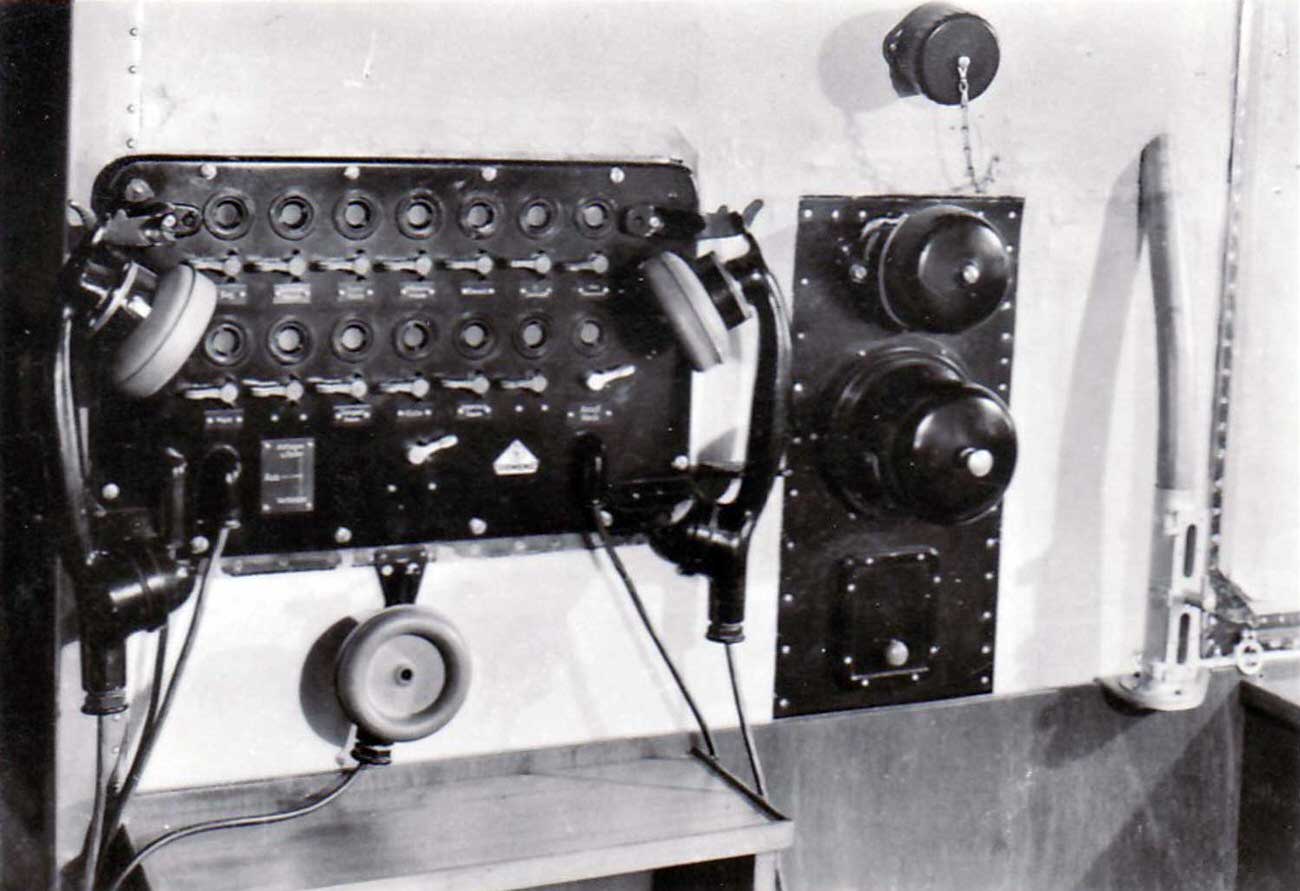
Tucked against a metal bulkhead, the main telephone station on the Hindenburg looks like a compact command center: rows of sockets and labeled ports, heavy handsets hanging ready, and thick cords looping down toward the shelf. The arrangement feels purposeful and industrial, more switchboard than household phone, built for clear communication in a noisy, vibrating environment. Even in a simple interior view, the hardware hints at how much coordination a giant airship required.
To the right, a separate panel of round, protruding components and a wall-mounted reel add to the sense of layered systems—telephone connections alongside other electrical controls, all within arm’s reach. The sturdy mounting plates, exposed fasteners, and utilitarian finishes tell a story of engineering priorities: reliability, quick access, and standardization. It’s a reminder that “inventions” aren’t only dramatic breakthroughs; they’re also the practical interfaces people depended on every day.
For readers interested in early aviation technology and airship history, this photograph offers a close-up of the communications infrastructure that helped keep operations synchronized between crew spaces. The Hindenburg’s telephone station stands as a fascinating snapshot of pre-digital connectivity, when routing a call meant plugging, switching, and listening through substantial equipment rather than tapping a screen. As a piece of technical heritage, it brings the era’s innovation down to human scale—hands, voices, and cables making an airship function like a flying community.