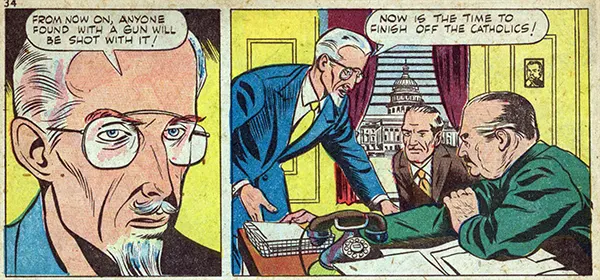
A lurid panel from *Is This Tomorrow: America Under Communism!* plunges readers straight into the fevered imagination of postwar America, where the political cartoon becomes a full-blown cautionary tale. The close-up of a stern, bespectacled figure and the hard-edged speech balloon—“From now on, anyone found with a gun will be shot with it!”—deliver instant menace, using blunt language and simplified features to make the threat feel personal and immediate.
Across the adjoining scene, suited men hunch over a desk with the U.S. Capitol visible through a window, a theatrical backdrop that frames power as something being hijacked from within. Another caption escalates the paranoia—“Now is the time to finish off the Catholics!”—revealing how this 1947-era propaganda comic fused anti-communist panic with sectarian fear, turning political conflict into an all-encompassing conspiracy. The bright, flat colors and exaggerated expressions are classic mid-century comic-book art, crafted to shock, persuade, and linger in the mind.
Seen today, the artwork reads less like reportage and more like a map of anxieties: disarmament as tyranny, government as compromised, and “enemies” imagined in sweeping, dehumanizing strokes. For collectors and researchers of Cold War propaganda, political comics, and American anti-communism, this piece offers a vivid example of how popular art carried ideology into everyday life. It’s a reminder that the style of the message—bold lines, sensational dialogue, and iconic symbols—can be as historically revealing as the message itself.