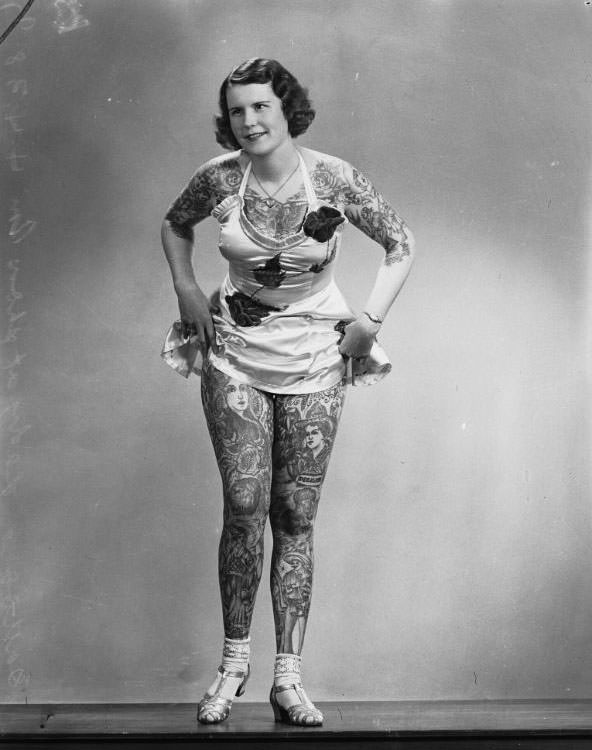
Betty Broadbent—billed as the “Tattooed Venus”—poses in Sydney on 4 April 1938 with the easy confidence of a seasoned performer. Set against a plain studio backdrop, she leans forward slightly, hands at her hips, wearing a light, patterned slip that frames rather than hides the artwork that made her famous. The clean lighting and full-length composition read like a publicity portrait designed to introduce audiences to a living gallery.
What stands out is the density and variety of tattooing across her arms, chest, and legs, arranged like illustrated panels meant to be viewed from every angle. Portraits and decorative motifs compete for attention along her thighs and calves, while the upper body carries bolder, darker areas that draw the eye upward toward her face. Even in monochrome, the contrast between ink and skin creates texture and depth, turning the human figure into an exhibition surface with its own narrative rhythm.
Seen today, the photograph offers more than spectacle; it’s a window into 1930s entertainment culture and the public fascination with tattooed women as stage attractions. Broadbent’s poised expression and deliberate stance suggest agency within a world that often marketed bodies as curiosities, reminding us how performance, fashion, and identity could intersect in surprising ways. For readers interested in tattoo history, circus and sideshow ephemera, or Sydney’s cultural life between the wars, this image is a compelling artifact of an era when “artworks” could walk on stage and greet the camera head-on.