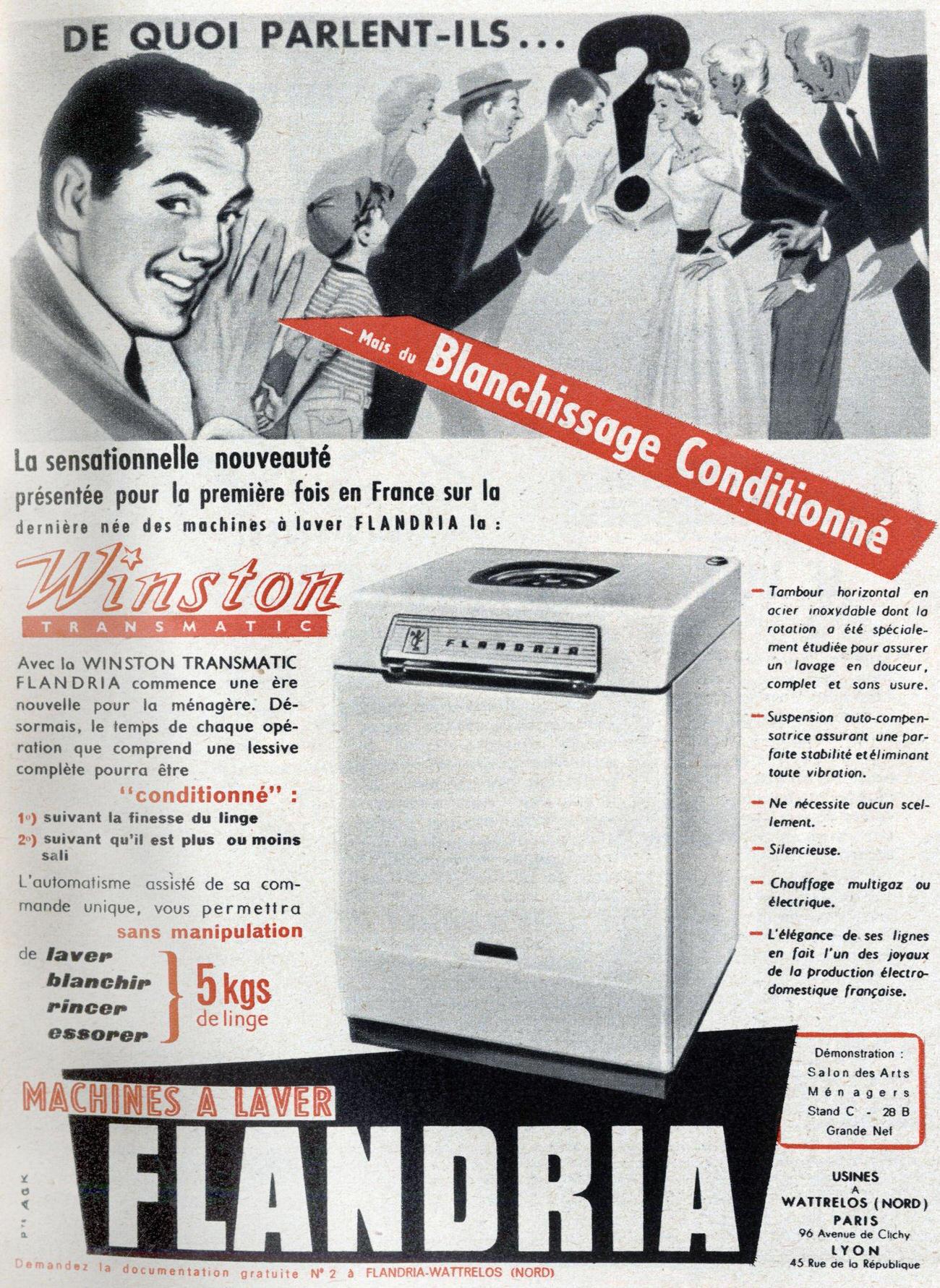
Bold French copy and a lively crowd scene set the tone for this 1958 Flandria washing machine advertisement, where curiosity (“De quoi parlent-ils…?”) is answered with a sweeping promise: “Blanchissage Conditionné.” The illustrated figures lean in as if sharing a secret, while a smiling spokesman at left invites the reader into the pitch—an effective bit of mid-century marketing that makes household technology feel like the talk of the town.
At the center of the page sits the machine itself, labeled “Winston Transmatic,” presented as a “sensationnelle nouveauté” and introduced as a modern breakthrough for the home. The text emphasizes automation with “sans manipulation,” and even specifies capacity—“5 kgs de linge”—framing the appliance as a practical invention designed to streamline the full routine of washing, bleaching, rinsing, and spinning.
Along the right-hand column, the selling points read like a checklist of postwar domestic aspirations: a horizontal stainless drum, stability that reduces vibration, quiet operation, and heating options (electric or multi-gas). The overall layout—big brand name “FLANDRIA,” technical features, and a polished product rendering—captures the era’s confidence in electrical domestic appliances, making this vintage advertisement a crisp window into 1950s consumer culture and the evolving history of the washing machine.