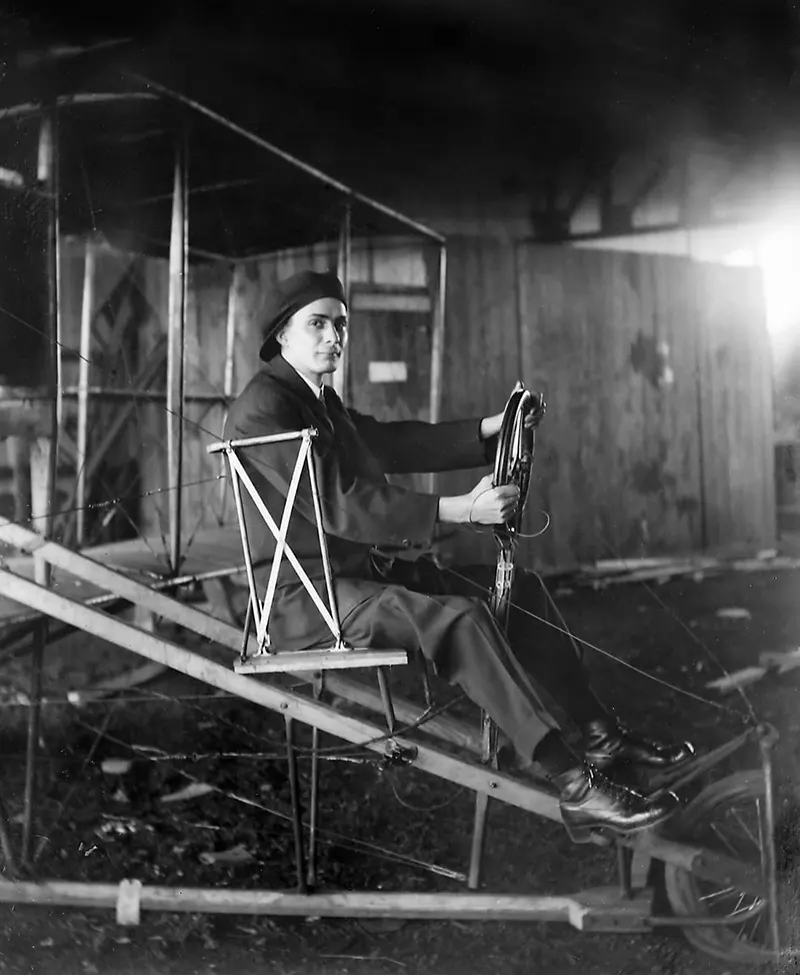
Perched on a narrow wooden frame, a sharply dressed man sits as if already in flight, hands set on a simple steering wheel and feet braced on the struts. Behind him rises a skeletal lattice of ribs and spars, suggesting wings or a tail section still in progress, while thin wires crisscross the structure like the rigging of a ship. The setting looks like a workshop or barn interior, cluttered and shadowy, where ambition and sawdust seem to share the same air.
Homemade flying machines like this belong to the era when aviation was still more experiment than industry, and daring often outran formal training. The contraption’s exposed framework—lightweight wood, tension wires, and minimal seating—reveals an inventor’s obsession with weight and balance, even if the final solution remained uncertain. It’s an arresting portrait of early innovation: a man posing confidently in a craft that feels half bicycle, half airplane, and entirely personal.
For readers drawn to invention history and early flight experiments, this photograph offers a vivid reminder that progress wasn’t only made in factories and laboratories. Many breakthroughs began in improvised spaces, built by people willing to test ideas with whatever materials they could source and shape. The image also makes a compelling SEO-friendly window into the world of DIY aviation, experimental aircraft design, and the restless imagination that helped turn the dream of human flight into something tangible.