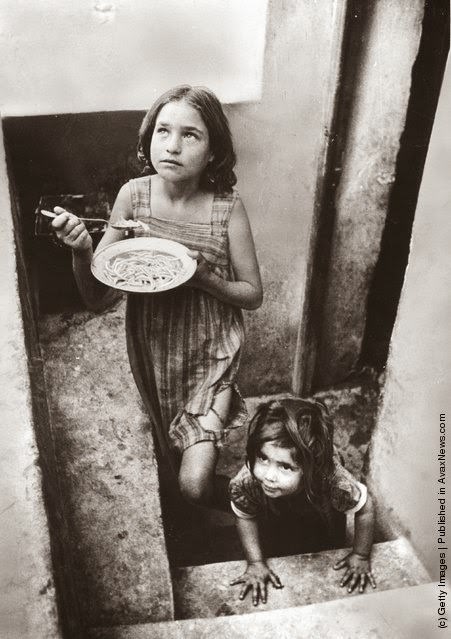
Down a narrow stairwell in Piraeus, two refugee children emerge from the dimness of a cellar, the older girl balancing a shallow bowl of food while the younger clings to the steps with both hands. The cramped walls and rough, stained surfaces press in on them, turning a simple climb into a passage from shadow to light. Their expressions—one searching upward, the other wary and fixed on the climb—carry the quiet strain of displacement more clearly than any caption could.
Taken during the Greek Civil War in 1947, the photograph points to the overlooked domestic side of conflict: hunger, overcrowding, and makeshift shelter in a port city where people arrived with little and waited with less. A cellar like this suggests more than poverty; it suggests families pushed underground by insecurity, relying on shared spaces that were never meant for children. The bowl and spoon become stark symbols of relief and scarcity at once, hinting at how daily survival narrowed to the next meal and the next safe corner.
For readers seeking historical context, this scene connects the Greek Civil War, refugee crises, and civilian life in postwar Greece through a single intimate moment. The setting at Piraeus—gateway to Athens and a hub of movement—underscores how ports can become both refuge and bottleneck when violence uproots communities. As a piece of documentary photography, it invites us to look past military narratives and consider what war does to childhood, dignity, and the spaces people are forced to call home.