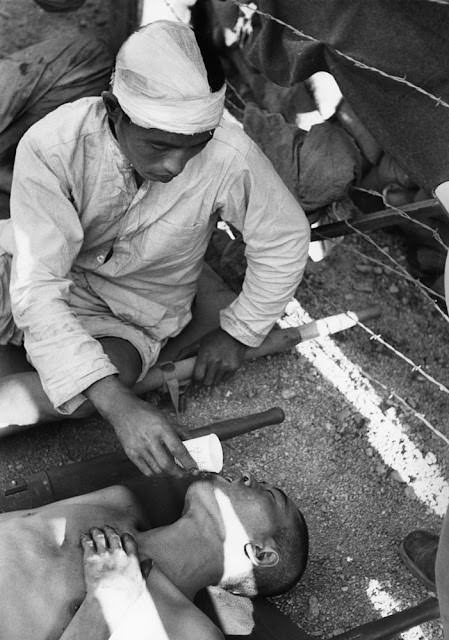
Bandages and bare skin meet the hard surface of a roadside in this 1952 scene, where wounded South Koreans are tended to with urgency and little privacy. One man kneels close, his own head wrapped, while he presses a cloth to the face of another who lies supine, eyes closed, jaw slack with exhaustion. The tight framing and the stark black-and-white tones draw attention to improvised care—hands, fabric, and breath standing in for the comforts of a proper clinic.
Barbed wire cuts diagonally through the foreground, a sharp reminder of how quickly borders and battle lines turn everyday spaces into dangerous corridors. Nearby legs and partial figures crowd the edge of the frame, suggesting a tense environment—helpers, bystanders, or comrades hovering as the injured are stabilized. Details like the rolled sleeves, the rough ground, and the minimal supplies speak to the realities of wartime triage during the Korean War era.
Civil conflict and international war often get summarized by maps and commanders, yet photographs like this pull history back to the level of the body and the moment. The title “Wounded South Koreans, 1952” anchors the image in a year when the fighting’s human toll remained relentless, even as negotiations and shifting fronts dominated headlines. For readers seeking Korean War history, wartime medical care, and the lived experience of civilians and soldiers alike, this photo offers a quiet, harrowing window into survival under pressure.