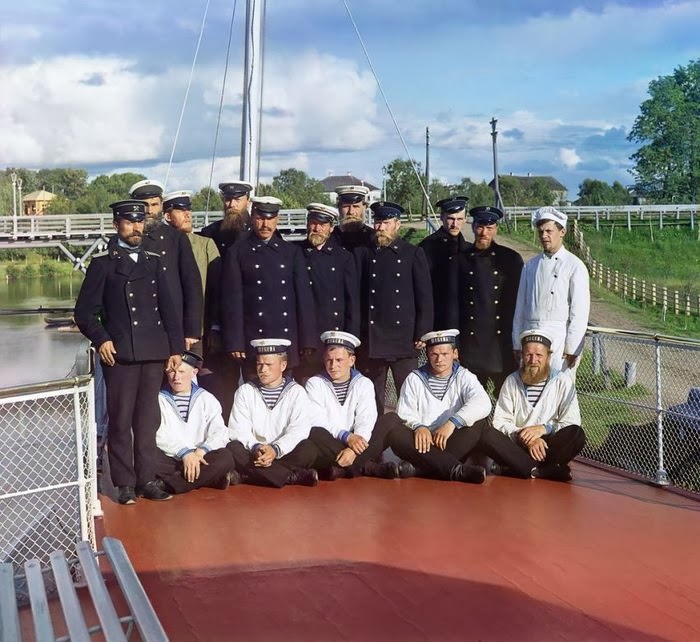
Uniforms and posture do most of the talking in this colorized group portrait of the crew of the steamship “Sheksna” of the M.P.S. in the Russian Empire, dated 1909. Dark double-breasted coats and peaked caps set the officers apart, while the sailors in light blouses and striped undershirts sit in front, forming a deliberate hierarchy that would have been instantly legible to contemporaries. Even without captions on their sleeves, the careful arrangement reads like a working roster made visible.
Aboard the vessel, the men gather on an open deck near railings and rigging, with a broad sweep of painted surface in the foreground that suggests a freshly kept working environment. Behind them, a low bridge, water, and a green shoreline anchor the scene in a riverine world of traffic and routine, where steamships linked towns and carried people, mail, and goods along dependable routes. The bright sky and summer light in the colorization soften the formality, hinting at a pause between duties rather than a staged studio sitting.
As a historical photo for WordPress readers interested in Russian maritime history, early 20th-century uniforms, and imperial-era transport, this image offers tactile detail: heavy wool, brass buttons, crisp collars, and weathered faces shaped by life on the water. The title’s reference to the “Sheksna” and the M.P.S. gives context without needing extra embellishment, letting the viewer focus on the human scale of an empire’s infrastructure. Colorization brings immediacy, but the real power lies in the quiet camaraderie of a crew documented at the threshold of a changing century.