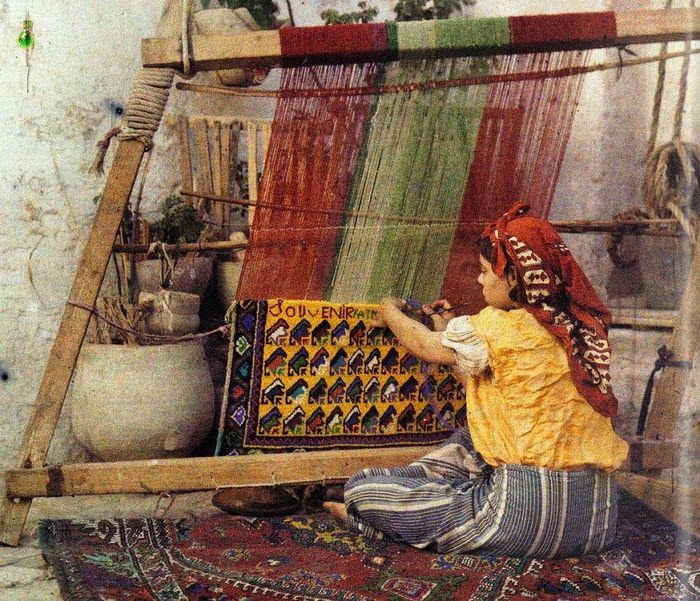
Threads of red, green, and warm earth tones hang taut across a simple wooden loom as a woman sits close to her work, hands poised in mid-knot. Her patterned headscarf and striped trousers echo the same love of rhythm and repetition that builds the carpet’s surface, while a richly colored textile beneath her creates a layered world of woven color. Even without movement, the scene feels alive with the steady tempo of craft—warp, weft, and patience.
Along the lower edge of the developing rug, bold geometric motifs and tiny house-like shapes form a repeating band, the kind of design that rewards slow looking. Behind her, everyday domestic objects—large pottery vessels, a rough plaster wall, and practical wooden supports—frame the loom and remind us that weaving was often embedded in home life rather than separated into a workshop. The image’s colorization draws attention to materials and dyes, making the palette feel immediate and tactile instead of distant.
Credited to Jules Gervais-Courtellemont and preserved within Albert Kahn’s ambitious photographic collection, this 1909 view from Algeria offers more than a record of technique; it suggests a lived relationship between maker, pattern, and place. Carpet weaving here reads as both labor and language, a way to store memory and taste in wool and geometry. For readers searching for early color photography, Algerian textile history, or the Albert Kahn Collection, this photograph provides a vivid doorway into the artistry of everyday life.