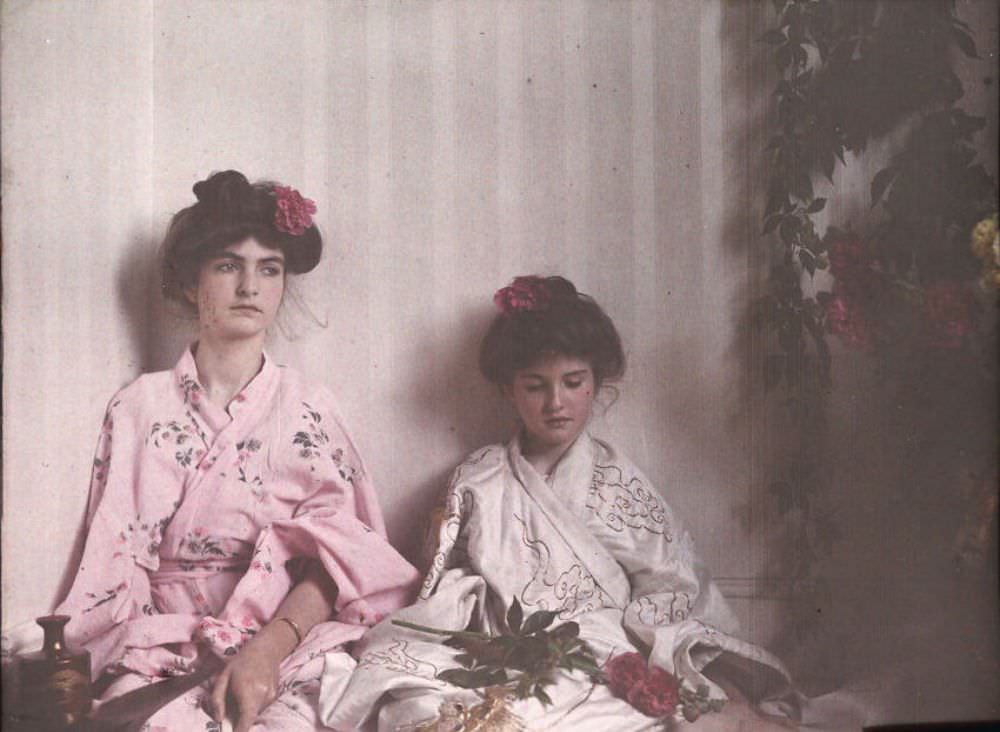
Soft color washes over a studio-like scene where two girls pose in “oriental costume,” their robes arranged in careful folds and patterned with delicate floral motifs. The older girl sits upright in a pale pink kimono-style garment, her hair pinned up and accented with a vivid flower, while the younger companion in a lighter robe lowers her gaze, holding a spray of greenery and blossoms. Against a simple backdrop, the styling and textiles become the focus, inviting close attention to embroidery, sashes, and the gentle drape of fabric.
Dated in the title to 1908, the portrait reflects an era when themed dress and exoticized fashions were popular subjects for photography, stage, and parlor entertainment. The word “oriental,” common in older captions, signals a Western framing rather than a precise cultural attribution, yet the clothing clearly draws inspiration from East Asian attire. Details like the floral hair ornaments and the wrap-front silhouette suggest a costume assembled for effect—part performance, part keepsake—capturing how global aesthetics were filtered into turn-of-the-century visual culture.
Colorization adds an extra layer of interpretation, bringing warmth to skin tones and lending the textiles a romantic softness that black-and-white cannot convey. The pink robe, the deep rose blossoms, and the muted background create a calm palette that emphasizes mood over spectacle. For readers interested in early 1900s photography, vintage costume, and the history of colorized images, this post offers a quietly intimate glimpse into how identity, fashion, and imagination intersected in a single posed moment.