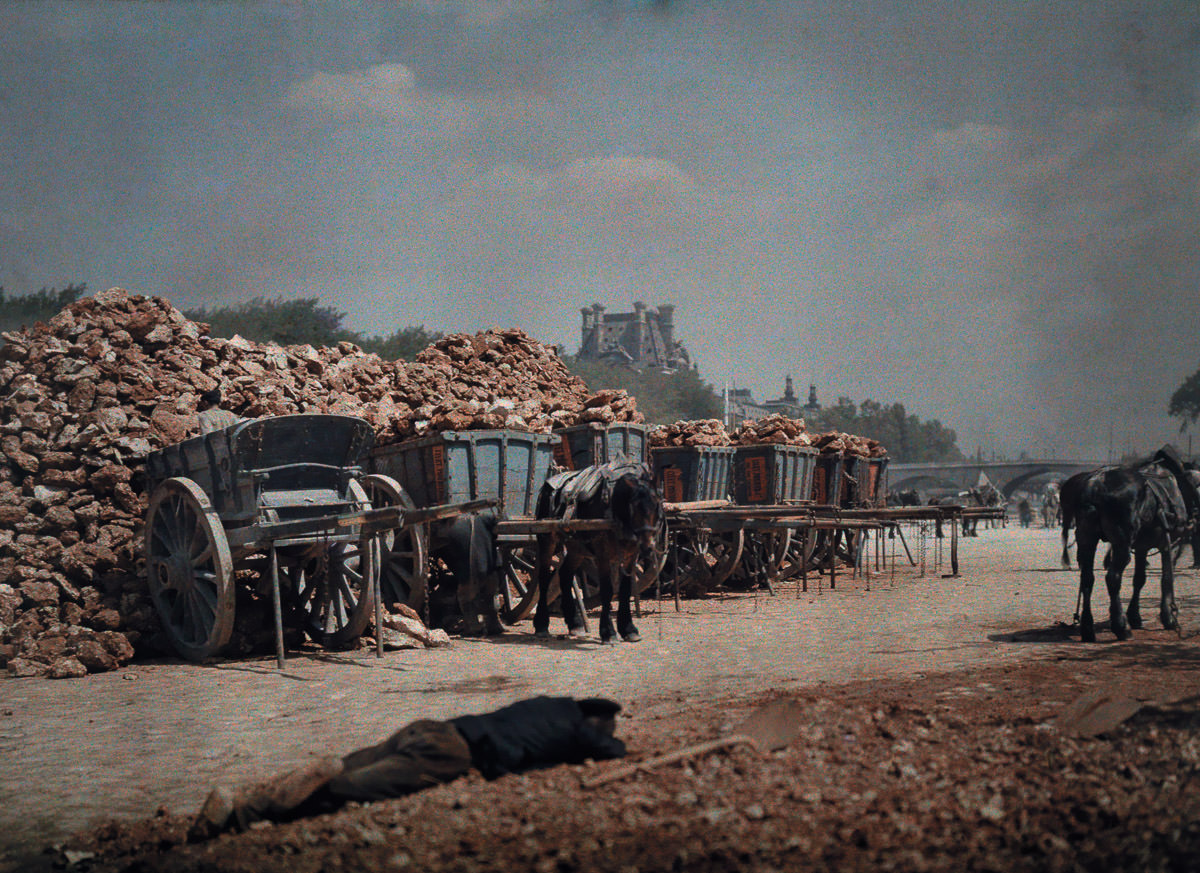
Along a broad Paris roadway in the 1920s, horse-drawn carts stand in a row beside towering heaps of broken stone and rubble, the kind of everyday material that quietly reshaped the city. The colorization brings out dusty browns and muted blues in the wagons, while the animals wait patiently in harness, framed by a hazy sky that suggests heat, grit, and constant motion. In the distance, a bridge arches over the scene, hinting at the familiar geometry of the Seine’s crossings without forcing the view into a single landmark.
What’s striking here is how industrial labor still leans on older rhythms: wooden wheels, heavy loads, and horses doing the hauling at street level. The piles look freshly dumped, as if pulled from demolition sites or excavation work, and the long line of carts implies an organized system of removal and delivery—Paris maintaining itself through endless cycles of tearing down and building up. Even in a city celebrated for cafés and couture, the 1920s were also about infrastructure, streetworks, and the practical business of modernizing a dense urban capital.
Colorization doesn’t just add pigment; it restores atmosphere, turning an archival moment into something almost tactile—the chalky rubble, the sun-warmed road, the dark sheen of a horse’s coat. For readers searching for “Paris 1920s” history, this image offers a grounded counterpoint to the era’s glamour, reminding us that the City of Light ran on labor as much as on legend. Pause on the details and it becomes a small documentary of urban life between tradition and change, captured in the middle of a working day.