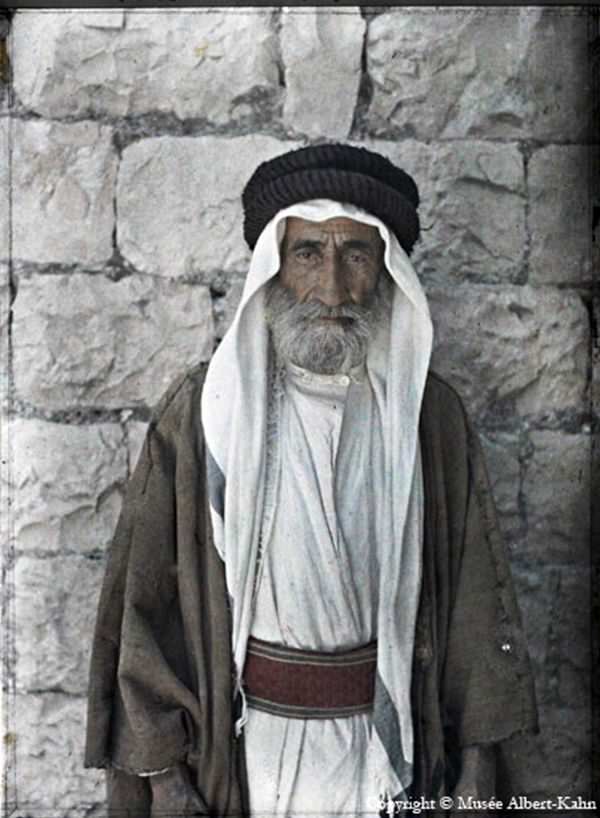
Weathered stone blocks form a stark backdrop for a single, steady figure, his gaze meeting the viewer with the quiet authority of age. The colorization brings out the earthy tones of a heavy outer cloak, the bright fall of a white head covering, and the dark wrap of a cap that frames a lined face and full grey beard. Little else competes for attention, which makes the portrait feel intimate—more a meeting than a document.
In the context of Palestine in the 1900s, clothing like this speaks volumes about daily life, climate, and social custom without saying a word. The layered garments suggest practical protection from sun and wind, while the broad sash at the waist hints at traditional ways of fastening and carrying essentials. Even the rough wall behind him reads like a fragment of place—ordinary architecture turned into a stage for identity and presence.
Colorization doesn’t change the original moment so much as it narrows the distance between then and now, inviting a closer look at texture, fabric, and expression. For readers searching for early 20th-century Palestine, portraits like this offer a grounded counterpoint to grand narratives: one person, one stance, and a lifetime written into posture. Spend a moment with his eyes and the careful folds of cloth, and the past feels less abstract, more human, and more immediate.