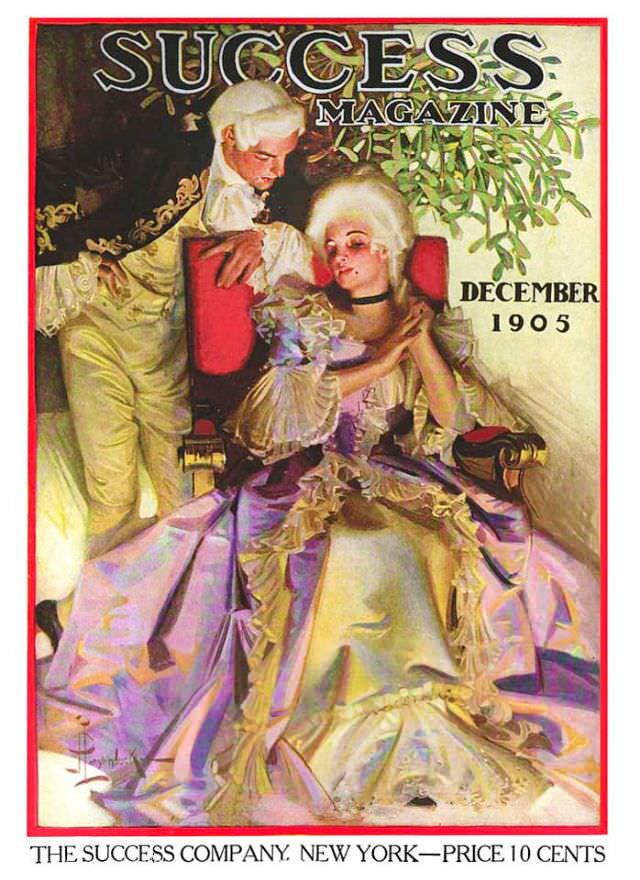
Gold-lettered “SUCCESS MAGAZINE” crowns this December 1905 cover, where a lavishly dressed couple inhabits a softly lit interior framed by a bold red border. The man leans in with a watchful, almost protective posture, while the seated woman rests in a voluminous gown whose pale satin and lavender tones ripple across the chair and floor. A leafy branch arches overhead, adding a decorative flourish that balances the elegant typography and the clean, open space around the date.
Costume and pose do much of the storytelling: powdered wigs, ornate embroidery, and ruffled cuffs evoke a romanticized aristocratic past, presented with turn-of-the-century illustration polish. The woman’s relaxed expression and the man’s attentive gaze create a quiet tableau of refinement—part theater, part dream—suggesting that “success” could be marketed not only as ambition, but as taste, leisure, and social assurance. Even the color choices feel intentional, with the rich reds and soft violets guiding the eye from title to figures to the crisp “December 1905” lettering.
At the bottom, the imprint line—“THE SUCCESS COMPANY, NEW YORK—PRICE 10 CENTS”—grounds the fantasy in the practical world of magazine stands and mass readership. For collectors of antique magazine covers and early 20th-century cover art, this piece offers a vivid example of how periodicals blended aspirational imagery with clear branding. As a historical artifact, it’s also a reminder that visual storytelling was central to publishing long before modern advertising, shaping how readers imagined culture, class, and progress in 1905.