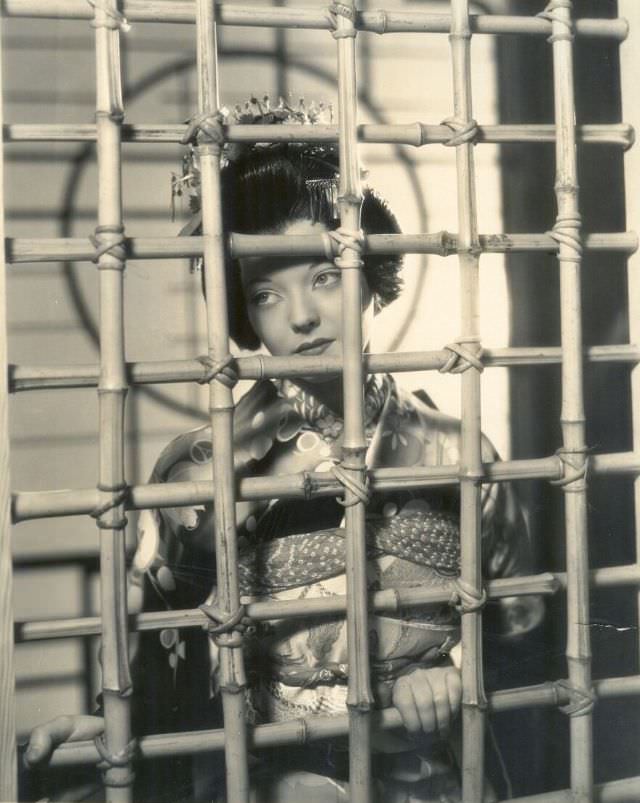
Framed by a lattice of bamboo, Sylvia Sidney appears in a moment of quiet intensity, her gaze turned slightly aside as if listening for footsteps just beyond the screen. The soft lighting and tight composition heighten the sense of separation and longing, drawing attention to her face and the careful styling that evokes the world of “Madame Butterfly.” Details in the costume—patterned fabric, layered textures, and a delicate hair ornament—signal classic studio craftsmanship from early-1930s cinema.
In “Madame Butterfly” (1932), this kind of still imagery was part of how Movies & TV promoted dramatic performances: a single pose could suggest an entire emotional arc. The barrier in the foreground reads as more than set dressing; it works as a visual metaphor, placing Sidney’s character between private feeling and public consequence. Even without motion or dialogue, the photograph leans into silent-era visual traditions that carried power into the talkies.
For fans of classic Hollywood and film history, this photo offers a compelling window into period costume design, studio portrait aesthetics, and the star-driven marketing of the time. It’s also a reminder of how adaptations like “Madame Butterfly” were translated into cinematic language through composition, light, and expression rather than spectacle alone. Whether you’re researching Sylvia Sidney or collecting memorable 1932 movie imagery, this still stands out for its atmosphere and storytelling restraint.