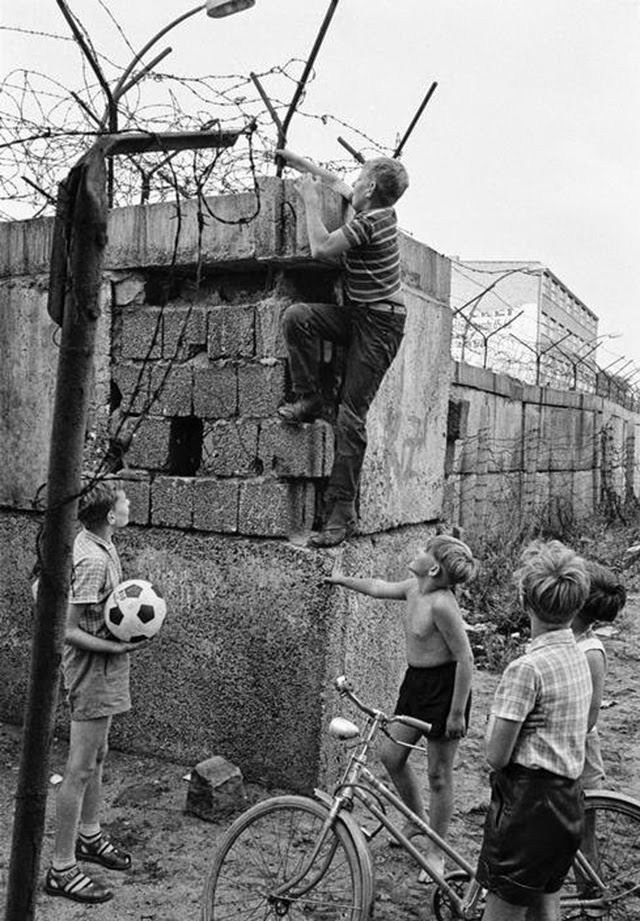
Along Bernauer Strasse, the Berlin Wall rises like a rough-built cliff of concrete and broken masonry, topped with tangles of barbed wire and harsh angles. In the foreground, a boy hauls himself upward, fingers searching for purchase near the top while a streetlamp and fence lines frame the scene with an uneasy normality. The surface is patched and uneven, its scars and gaps turning a political boundary into something disturbingly climbable.
Below, everyday childhood props sit right against the edge of a divided city: a soccer ball held at the hip, a bicycle leaned close, and four children watching as if this were a daring game. One points up, another stands back, all eyes fixed on the climber’s next move. That contrast—playground energy set against militarized architecture—makes the photograph unforgettable, capturing the way ordinary lives pressed up to extraordinary restrictions.
The moment speaks to the Berlin Wall’s presence not only as a Cold War symbol but as a lived barrier that cut through streets, routines, and neighborhoods. Bernauer Strasse became shorthand for separation, and images like this remind us how quickly children absorb the geography of fear and curiosity alike. For readers searching Berlin Wall history photos, this scene offers a stark, human-scale view of division: not speeches or maps, but kids measuring freedom in handholds.