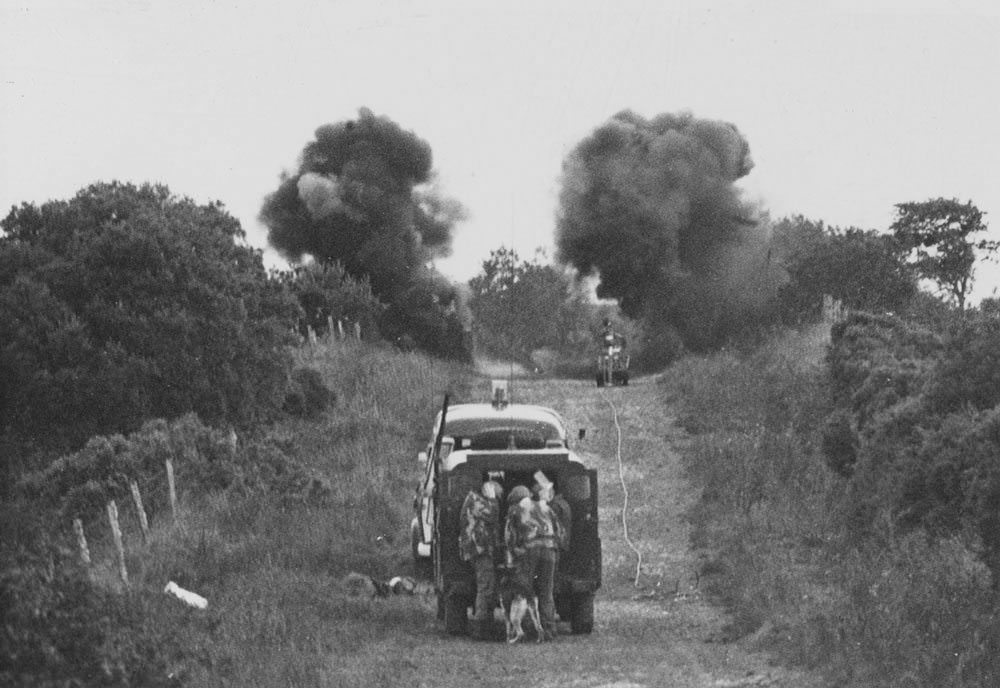
Smoke columns billow upward beyond a narrow country lane as a controlled blast erupts in the mid-distance, turning an otherwise quiet border landscape into a scene of sudden force. In the foreground, a small group of soldiers gathers at the rear of a vehicle, their attention fixed on the detonation, while a dog stands close by—an almost domestic detail set against the hard realities of security work. The road is hemmed in by hedges and trees, emphasizing how confined these operations could be, even in open countryside.
According to the title, the men belong to the 321 Explosive Ordnance Disposal Company of the Royal Army Ordnance Corps, carrying out a detonation near the Irish border in 1975. The long line trailing along the roadway suggests careful preparation and distance, the kind of methodical procedure that defined EOD practice when dealing with suspect devices. The photograph conveys both routine and risk: a choreographed sequence of steps, performed in an environment where the next incident could arrive without warning.
Border security during the 1970s demanded technical skill as much as courage, and images like this help ground that history in tangible detail. For readers searching for Royal Army Ordnance Corps history, Explosive Ordnance Disposal in 1975, or photographs connected to the Irish border conflict, this frame offers a stark, immediate reference point. It also reminds us that “civil wars” and internal unrest are experienced not only in political headlines, but on back roads where specialists work to make danger briefly visible—then safely gone.