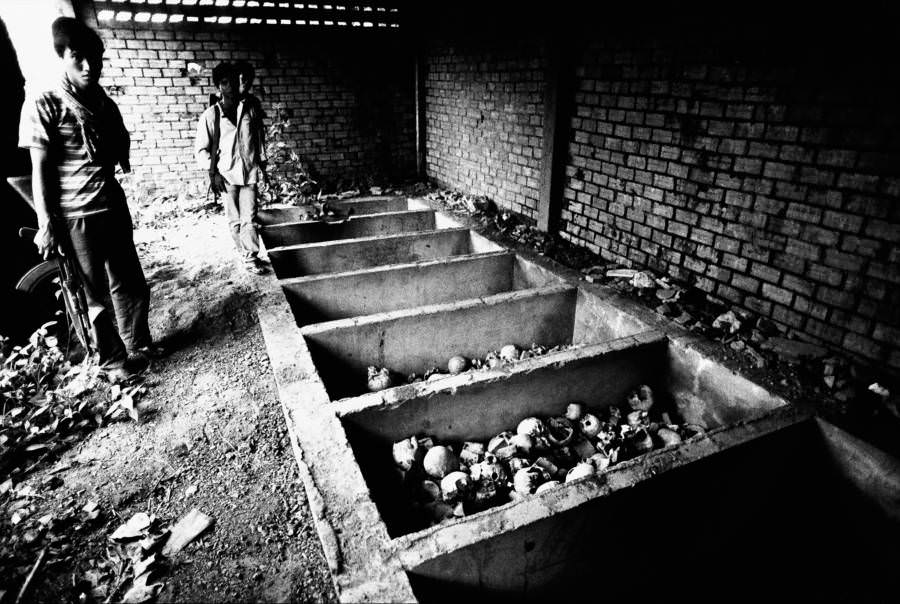
Under a low roof and against rough brick walls, a soldier stands watch beside a row of open concrete pits, their edges catching the harsh light. The foreground is crowded with skulls and bones, while debris and dry leaves collect in the corners, giving the space the feel of an abandoned outbuilding turned into a ledger of death. Another figure lingers deeper in the frame, and the angled perspective draws the eye pit by pit toward the darkness at the back.
Oudong, Cambodia, in 1981 sits in the long shadow of civil wars, when the aftermath of violence was still visible in the ground as much as in people’s lives. The rifle at the soldier’s side speaks to a country not yet at peace, even as the scene suggests a grim effort to guard, document, or recover what had been hidden. In the absence of ceremony, the orderly geometry of the graves feels almost administrative—an attempt to contain the uncontainable.
For readers searching the history of Cambodia’s conflicts, mass graves, and postwar reckoning, this photograph offers an unflinching, close-range view of how trauma was encountered on a daily basis. It does not rely on grand monuments or distant battlefields; instead it places the viewer in a confined space where evidence and silence share the same air. The image endures as a reminder that the work of remembrance often begins with what remains, and with those tasked to stand beside it.