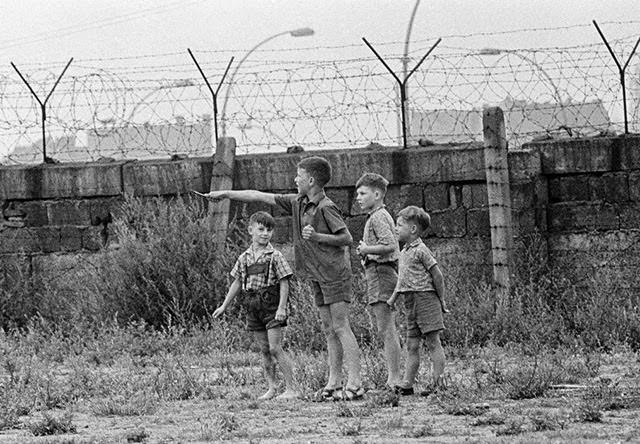
Four boys drift across a scrubby patch of ground, their attention caught by something beyond a stark barbed-wire fence that cuts the horizon. One points with an outstretched arm, as if explaining a sight just out of frame, while the others cluster close in a mix of curiosity and caution. Behind them, a heavy wall and angled posts make the boundary feel permanent, yet the children’s casual posture suggests how quickly extraordinary conditions can become everyday scenery.
Along the border between East and West Berlin, barriers were not only instruments of state power but also part of the neighborhood landscape—looming over play, conversation, and routine errands. The rough grass and rubble-like terrain hint at a “no man’s land” atmosphere, where empty space was engineered into separation. In that uneasy quiet, childhood persists, turning a tense geopolitical line into a backdrop for games and small adventures.
The title’s focus on boys playing near the Berlin border underscores the unsettling contrast at the heart of Cold War history: innocence at the edge of danger. Barbed wire, concrete, and watchful infrastructure speak of control and division, while the children’s faces and body language speak of ordinary life pressing on. For readers searching for Berlin Wall photos, East and West Berlin border images, or the human stories behind divided cities, this scene offers a poignant reminder that history often unfolds in the spaces where people live.