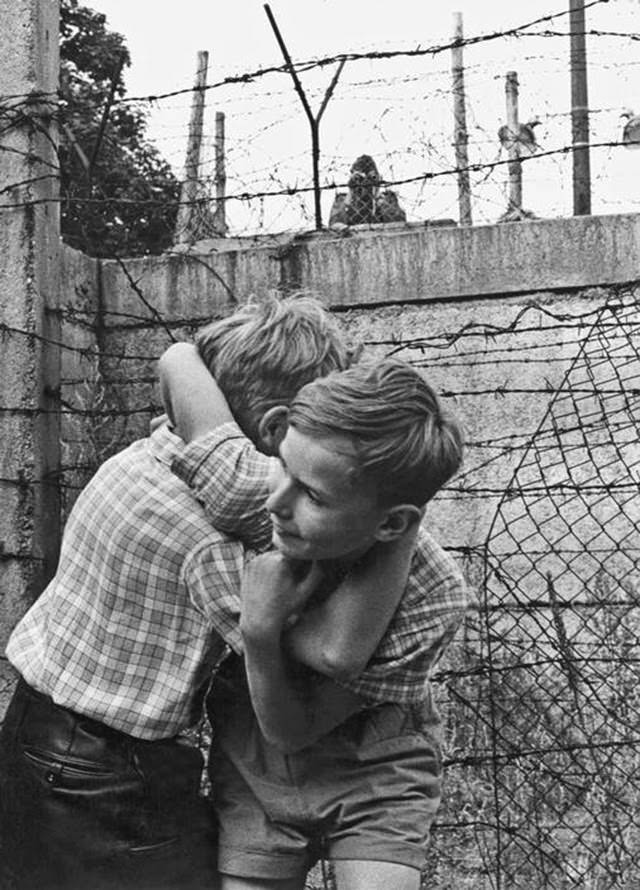
Near Bernauer Strasse, two boys lock arms in a rough, almost playful grapple on the western side of the Berlin Wall, their checkered shirts and tense shoulders filling the foreground. Behind them rises a harsh lattice of barbed wire and fencing, a makeshift geometry of division that turns an ordinary scrap into something staged by history itself. The closeness of their bodies contrasts with the cold, engineered distance imposed by concrete and steel.
Above the barrier, an East German border guard peers through binoculars, reduced to a dark silhouette framed by posts and wire. The moment feels like a small “civil war” of the Cold War: not armies on a battlefield, but children and neighbors living under surveillance, where even a scuffle becomes part of the border’s theater. In this Berlin Wall photograph, watchfulness is as prominent as the wall, and the act of looking becomes another weapon.
What lingers is the uneasy normality—youthful energy colliding with a system built to control movement, sightlines, and contact. The image invites readers to consider how daily life in divided Berlin was shaped by power at close range, with Bernauer Strasse standing as one of the most charged stretches of the border. For anyone searching Berlin Wall history, Cold War Berlin, or life near the Wall, this scene distills the era into one tight frame: play, pressure, and a gaze from the other side.