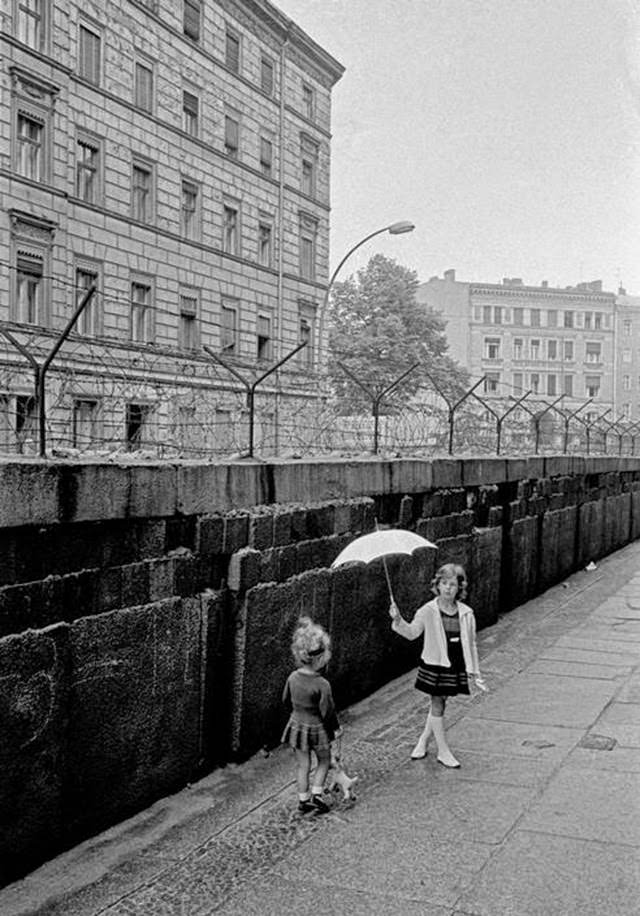
Along a stark stretch of the Berlin Wall on its western side, two children turn an intimidating boundary into the backdrop of an ordinary afternoon. The concrete slabs loom dark and heavy, topped with barbed wire and fencing, while tall apartment façades rise behind them like quiet witnesses to a divided city. One child holds an open umbrella, an almost playful prop against the hard geometry of surveillance and separation.
The scene’s power lies in its contradictions: childhood movement and curiosity pressed up against a structure designed to stop movement entirely. Cracked pavement, the long shadowed run of the barrier, and the utilitarian streetlamp underline how the Cold War entered everyday life, not only in speeches and checkpoints but in sidewalks and games. Even without visible guards, the Wall’s presence dominates the frame, shaping what is possible and where a simple walk can lead.
For readers searching for Berlin Wall history, Cold War Berlin, or daily life in divided Germany, this photograph offers a grounded, human-scale perspective. It invites reflection on how communities adapted to the border cutting through neighborhoods, and how children learned the contours of their world with the Wall standing close by. In the end, the image speaks less about grand strategy than about resilience—small lives continuing within the shadow of a global conflict.