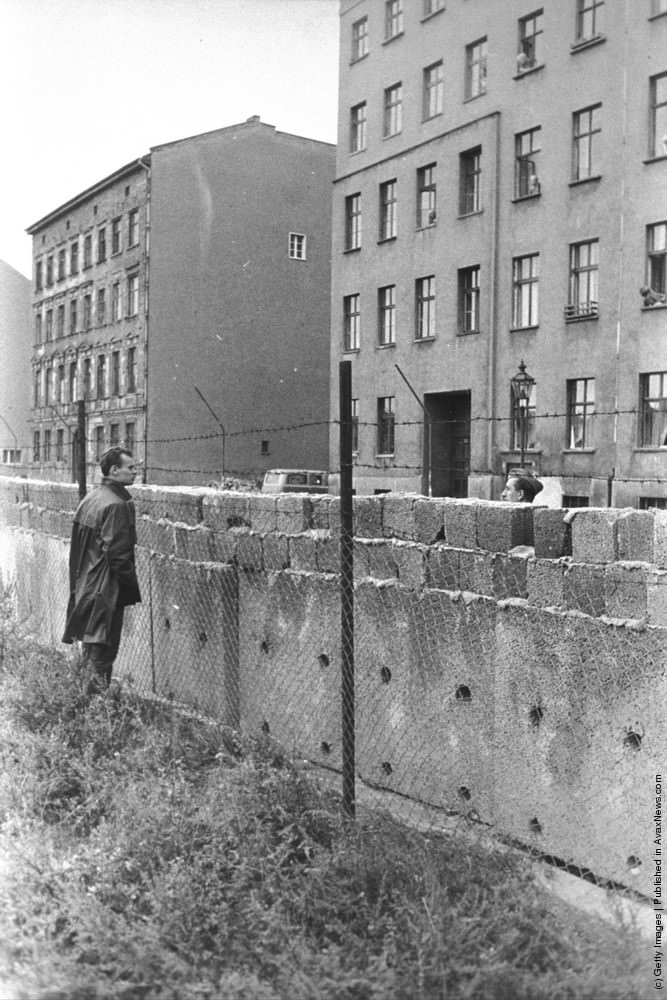
Along a rough line of concrete and wire, an East Berliner stands close enough to speak yet far enough to feel the distance, peering through barbed strands toward a West Berliner on the other side. The Berlin Wall, still in its earlier, improvised form, reads here as a neighborhood boundary turned into a border regime—low blocks, a chain-link fence, and a strip of scrubby ground that seems suddenly off-limits. Behind them rise plain apartment facades with open windows, a reminder that ordinary domestic life continued within sight of an extraordinary division.
The tension in the scene comes from its quietness: no crowds, no dramatic gestures, only two figures facing each other across a barrier built to prevent contact. The wire cuts the middle distance like a drawn line, while the wall’s pocked surface and uneven masonry suggest hurried construction and constant adjustment. Even the streetlamp and parked car in the background feel like props from a normal city, made strange by the presence of fortifications where a street might once have run.
In the broader story of Cold War Berlin, moments like this illuminate what grand political slogans often conceal—how the Iron Curtain could land in the middle of familiar streets, friendships, and families. For readers searching for Berlin Wall history, East Berlin vs. West Berlin images, or everyday life in divided Germany during the 1960s, this photograph offers a stark, human-scale perspective. It captures the uneasy proximity of two worlds: close enough for a glance, separated by concrete and barbed wire.