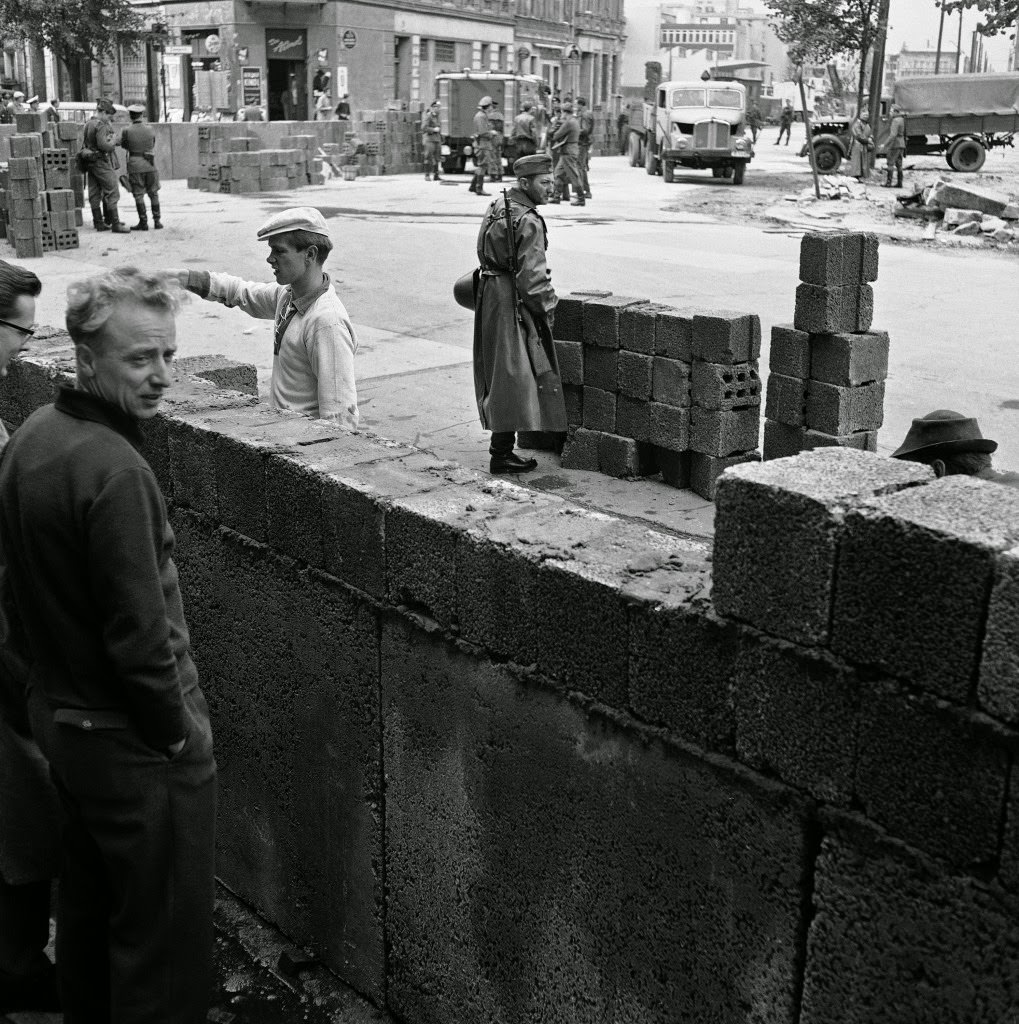
On August 18, 1961, East Berlin streets became work sites and checkpoints at once, as cinder blocks were stacked into a rough wall that signaled the hardening of the city’s division. In the foreground, unfinished masonry rises quickly, its porous blocks forming a barrier still low enough to see over, yet already heavy with meaning. Soldiers and workers occupy the roadway, turning an everyday urban corner into a controlled boundary line.
Behind the new barrier, trucks idle and uniformed men stand watch, their posture suggesting that the building project is also an enforcement operation. The scene feels improvised—blocks piled in columns, gaps waiting to be filled—while civilians linger nearby, caught between curiosity and dread. That mix of movement and uncertainty reflects the unrest described in the title, when the separation of neighborhoods and families was being made physical in real time.
As a historical photo from the early days of the Berlin Wall, this moment captures how quickly Cold War politics translated into concrete and labor. The cinder block wall in East Berlin appears less like a finished structure than a statement under construction, one that would reshape daily life and the geography of the divided city. For readers searching Berlin Wall history, East Germany, and August 1961, the image offers a stark reminder that monumental borders often begin as stacks of ordinary blocks on a familiar street.