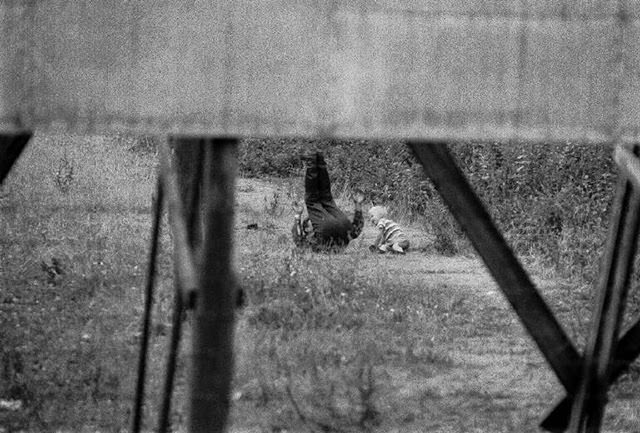
Behind a barbed wire fence on the Berlin border, an unexpected scene unfolds in the grass: an East German guard has dropped into a playful pose, legs lifted as if mid-gymnastic routine, while a small boy sits nearby and looks on. The barrier is present but not centered; instead, the eye is drawn to the quiet patch of ground where two lives briefly share the same ordinary moment. Tension lingers in the metal and posts, yet the mood on the path is oddly gentle.
The soldier’s uniform and the child’s casual posture create a striking contrast between duty and childhood curiosity, made sharper by the thin strip of distance the fence enforces. Even without dramatic action, the photograph speaks to the daily reality of divided Berlin, where borders were not only geopolitical lines but constant physical features shaping what people could see, say, and do. In that narrow corridor of grass, the guard’s relaxed gymnastics reads like a small human gesture pushed up against an immense system.
Civil conflict isn’t always a battlefield; sometimes it appears as a quiet standoff between wire and wonder, where play becomes its own kind of commentary. For readers searching for Berlin Wall history, East and West Berlin border images, or Cold War photographs of everyday life, this frame offers a rare look at softness inside a hardened landscape. It reminds us how easily a child’s attention can pierce propaganda, and how quickly a guarded frontier can reveal the ordinary people tasked with maintaining it.