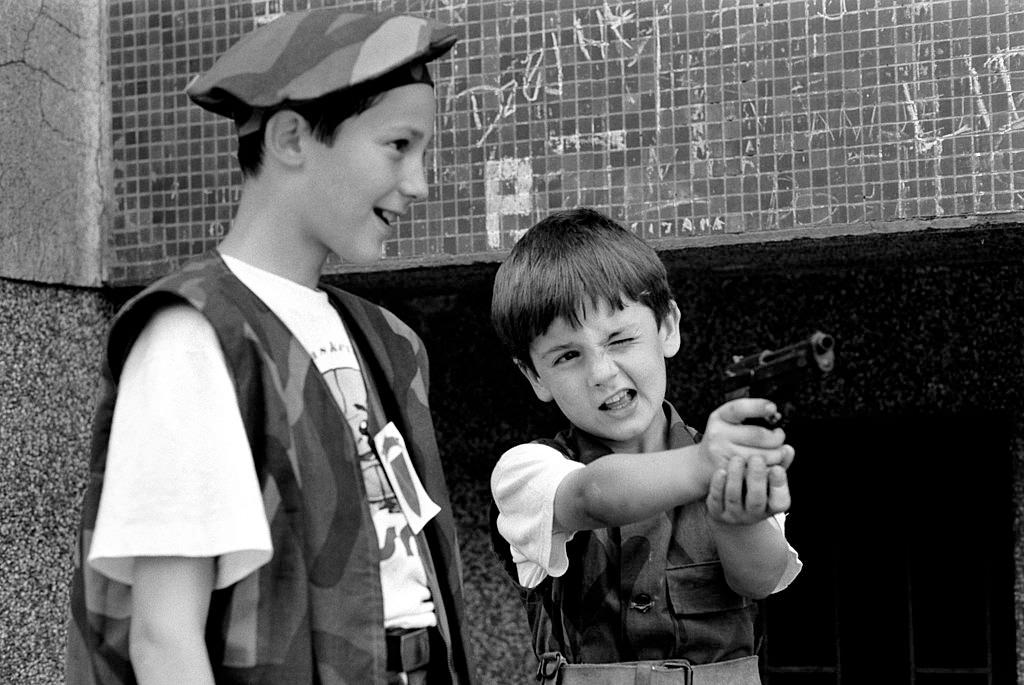
Caught between childhood play and the hard edge of war, two boys wear the camouflage-style uniform associated with Bosnian army fighters while one raises a real pistol with both hands. His face tightens into a squinting “aim,” a gesture that mimics what he has likely seen in streets and on television, while the other boy stands close by, half-smiling, as if this were an ordinary game. Behind them, a wall of small tiles and worn concrete adds a stark, everyday backdrop—no battlefield in sight, just the normal surfaces of civilian life.
The title’s timeframe, July 1992, places the scene in the early months of the Bosnian War, when civil conflict quickly transformed neighborhoods into front lines and blurred the boundary between home and combat. What makes the photograph so unsettling is its scale: a handgun in a child’s hands, a uniform hanging on small shoulders, and the casual proximity of a friend who seems unafraid. The image quietly suggests how rapidly militarized symbols and real weapons could enter spaces where they never belonged.
For readers searching civil wars, Bosnia 1992, or Bosnian War photo history, this moment speaks to the psychological landscape of conflict as much as its politics. It documents the way war seeps into the routines of the young—through clothing, gestures, and the normalization of danger—leaving historians to read not only what is visible, but what is implied. In a single frame, innocence and indoctrination sit side by side, offering a painful reminder of what civil wars do to childhood.