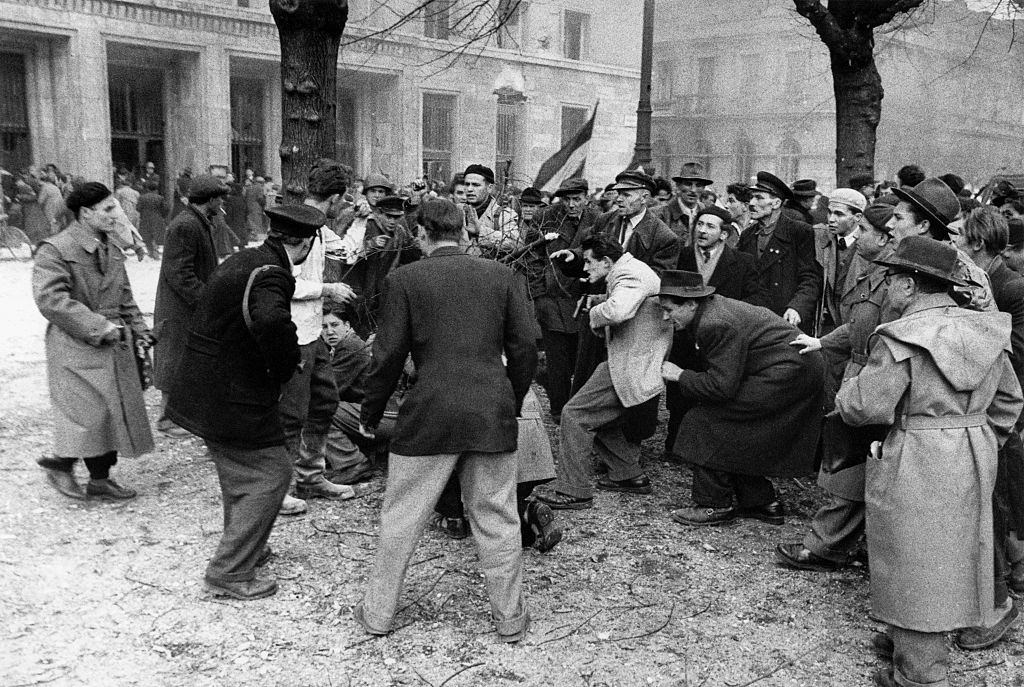
Anger compresses into a tight ring of bodies in this Budapest street scene from November 1956, where a member of the Hungarian secret police (ÁVH) stands trapped in the crowd’s orbit. Men in heavy coats and brimmed hats lean forward, arms raised, faces turned toward the center as if the whole square has become a courtroom without a judge. Bare tree branches and a stark building façade frame the confrontation, emphasizing how public and inescapable the moment has become.
The title points to the explosive context of the Hungarian Revolution of 1956, when the hated symbols of state security suddenly found themselves exposed to the people they had monitored and intimidated. Here, the human geography of revolt is visible: a mixture of bystanders and participants, momentum pulling everyone closer, and the contagious certainty that authority has shifted. It reads like a snapshot of civil conflict—an ordinary urban space abruptly transformed into a stage for retribution, fear, and hurried decisions.
For readers searching the history of Budapest 1956, the ÁVH, or the street-level realities of uprising and counterpower, this photograph offers an unvarnished entry point. It reminds us that revolutions are not only fought at barricades or negotiated in offices, but also enacted in moments like this—crowds forming, accusations shouted, and lives pivoting in seconds. The scene lingers as a warning about what happens when secret policing collides with a public that no longer consents to be silent.