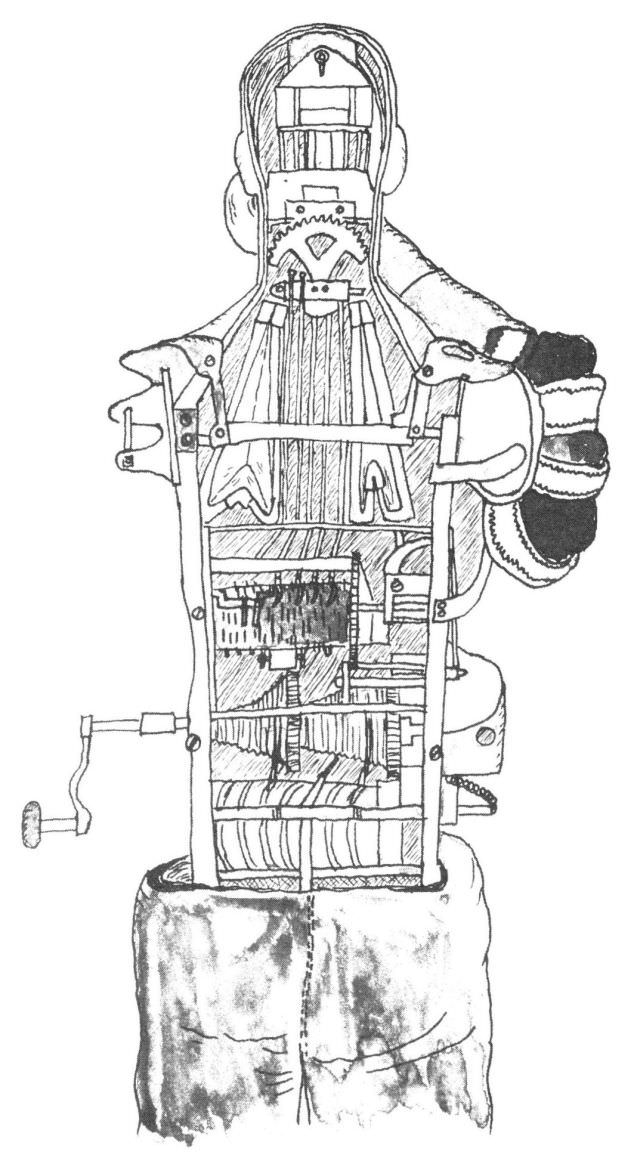
Curiosity sits at the heart of the Kaufmann Trumpeter, a clever contrivance that tried to make music by mechanical means. The illustration reveals a cutaway view of the figure’s torso, where gears, levers, and channels are arranged like an anatomical diagram—except the “organs” are engineered parts designed to perform. Even without a visible setting or maker’s label, the drawing reads as an advertisement for ingenuity: a self-contained performer built to mimic a human musician.
Leather bellows served as lungs, pushing air through reeds intended to imitate the voice of a brass instrument, and that ambition is written into the machine’s layered interior. A hand-crank at the side suggests how the device was powered, while the dense cluster of components hints at the fine balancing act required to produce steady tone and timing. Seen this way, the Kaufmann Trumpeter belongs to the long history of inventions that blurred entertainment, craft, and early automation—part music-making, part mechanical theater.
For readers interested in historical technology, automata, and the evolution of sound imitation, this image offers a window into how inventors visualized performance as a system of airflow and motion. The technical drawing style emphasizes function over spectacle, inviting you to trace the path from mechanical “breath” to reed vibration and onward to the imagined trumpet-like sound. It’s a reminder that long before electronics, experimenters were already chasing lifelike audio effects with nothing more than wood, leather, metal, and patient design.