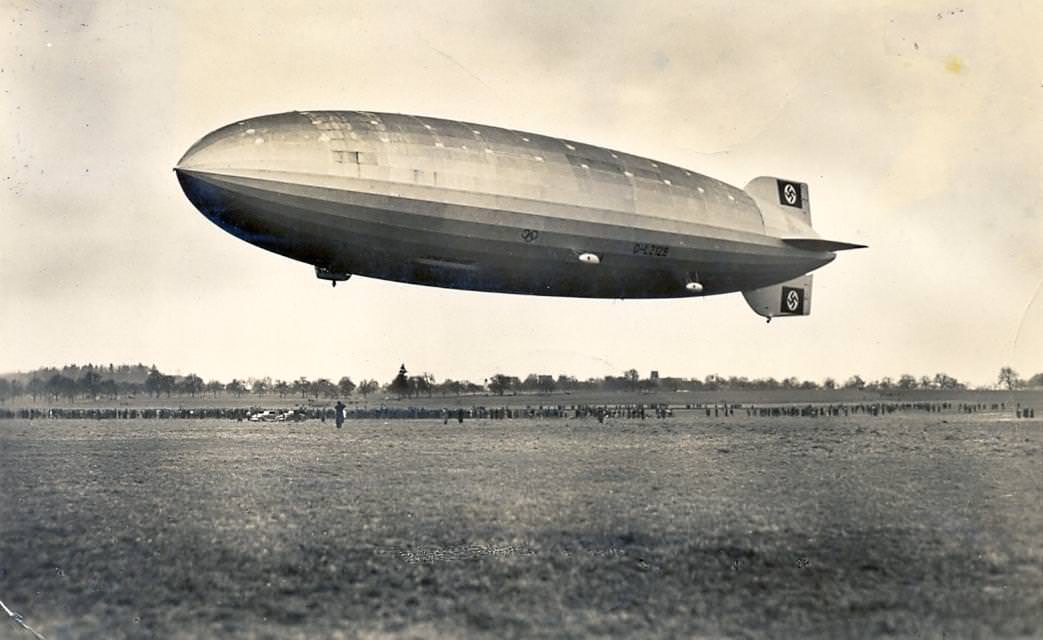
Gliding low over an open field, the German airship Hindenburg appears almost unreal in scale, its long silver hull hovering just above the ground as spectators cluster along the edge of the landing area. The title places the moment on its first flight, March 4, 1936, and the photograph conveys that sense of a debut: careful altitude, watchful crowds, and the controlled calm of a giant machine testing the air. Even at a distance, the details of the tail fins and the smooth, riveted skin speak to the engineering ambition behind interwar aviation.
Airships like this were promoted as a modern answer to long-distance travel—quiet, luxurious, and capable of carrying passengers and mail across oceans with a grandeur airplanes of the era struggled to match. Here, the composition emphasizes that promise by setting the craft against a broad sky and a flat horizon, letting the viewer measure technology against landscape and human scale. The Hindenburg’s presence dominates the frame, turning a simple field into a stage for one of the twentieth century’s most famous inventions.
For readers interested in aviation history, early airship design, or the culture of 1930s “future travel,” this photo offers a vivid snapshot of optimism before later events reshaped the public’s view of rigid dirigibles. It’s a reminder that breakthroughs often arrive wrapped in ceremony, drawing crowds who come not only to watch a flight, but to witness a new era they hope is beginning. As a historical image for a WordPress post, it pairs well with discussions of engineering, transportation, and the rise—and sudden fragility—of airship dreams.