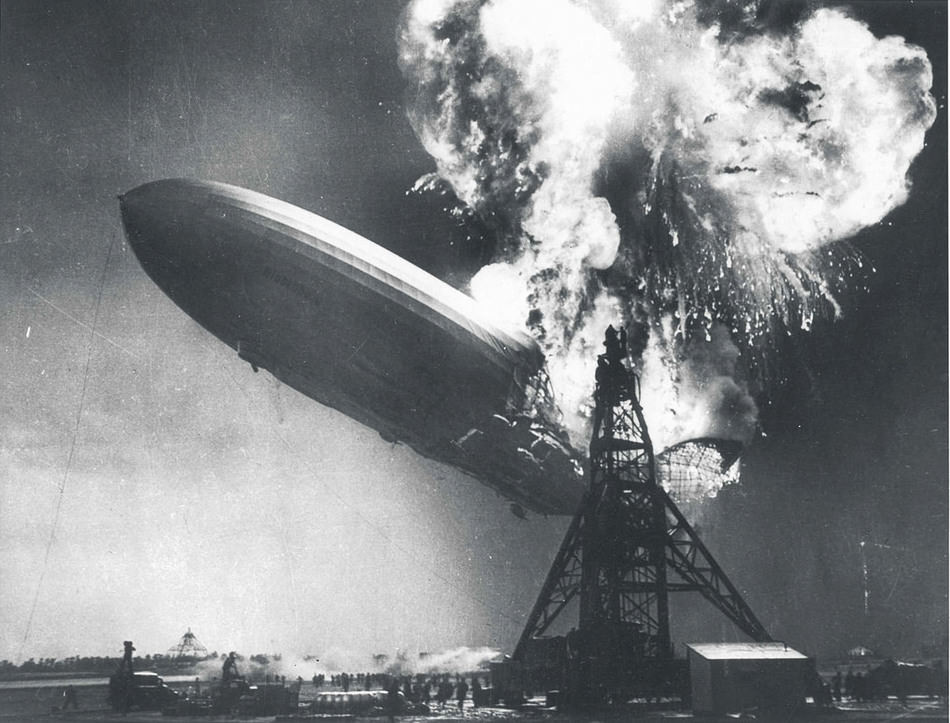
Flames billow from the Hindenburg as the great German zeppelin tilts toward the mooring mast at Lakehurst, New Jersey, freezing a few catastrophic seconds that changed aviation history. The airship’s sleek hull—built to symbolize modern engineering and transatlantic ambition—appears suddenly fragile against the dark sky, while a towering burst of fire and smoke consumes its upper structure. Below, small figures and ground equipment underscore the scale of the disaster, turning an icon of innovation into a scene of urgent chaos.
At the center of the frame, the mooring mast stands like a stark landmark, its latticework silhouetted against the blaze and illuminated by the inferno overhead. The composition draws the eye from the calm curve of the zeppelin’s body to the violent eruption near the tail, revealing how quickly a controlled landing could become an emergency. Details on the airship’s skin are faint but visible enough to remind viewers that this was not a distant spectacle—it was a real machine, brought low in front of witnesses and cameras.
Few events did more to puncture the public’s confidence in passenger airships than the Hindenburg crash on May 6, 1937, and this photograph remains one of the most enduring images of that turning point. For historians of inventions and transportation, it marks the collision between bold technological dreams and hard lessons about safety, materials, and risk. As a vintage record of the Lakehurst disaster, the photo invites reflection on how rapidly the age of the zeppelin gave way to the airplane era, and why the Hindenburg still haunts the story of flight.