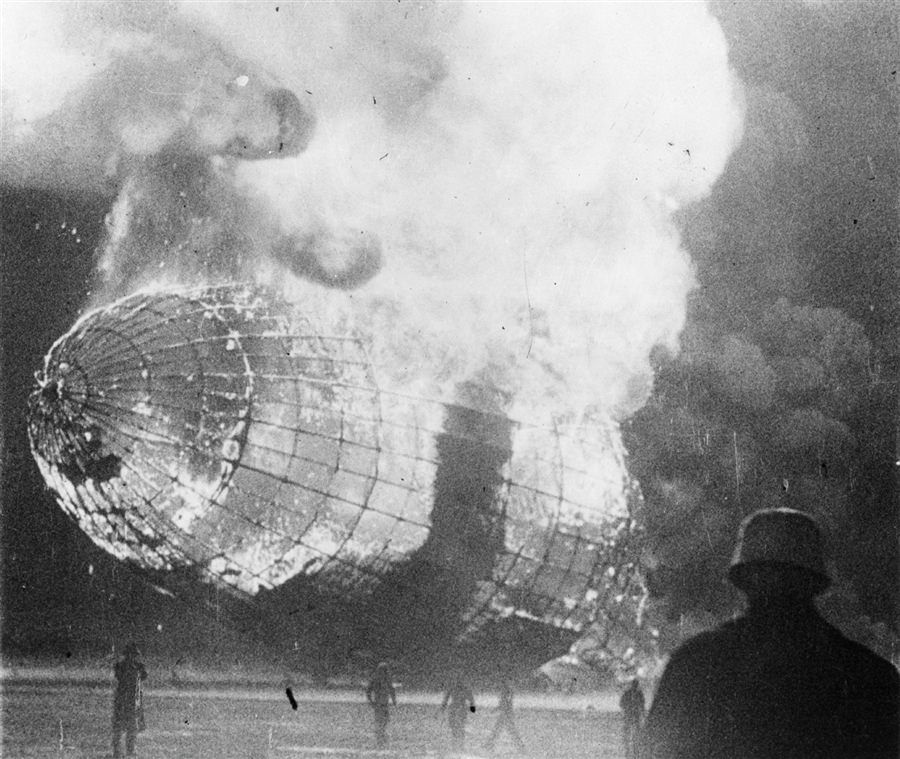
Night and fire collide in this stark view of the Hindenburg disaster at Lakehurst, New Jersey, on May 6, 1937. The great airship’s skeletal ribs glow through a rolling cloud of smoke, its streamlined form collapsing into a brilliant, chaotic blaze. In the foreground, small human silhouettes and a dark onlooker’s profile emphasize the scale of the dirigible as it comes down in flames.
For an era that celebrated invention and modern travel, the Hindenburg had been a floating emblem of technological confidence—until this moment rewrote the story. The photo freezes the instant when engineered elegance gives way to catastrophe, turning a controlled arrival into an uncontrolled inferno. Details like the bright lattice of the frame and the thick, billowing plume make the violence of the burn feel immediate even decades later.
Viewed today, the scene remains one of the most haunting images in aviation history and a key reference point in discussions of airship safety and public trust in new technologies. The title anchors the event to its place and date, while the photograph itself conveys what words struggle to match: the speed, heat, and disbelief surrounding the Hindenburg’s final moments. For readers searching the Hindenburg in flames, Lakehurst 1937, or the Hindenburg explosion, this historical photo offers a sobering window into a turning point of the 20th century.