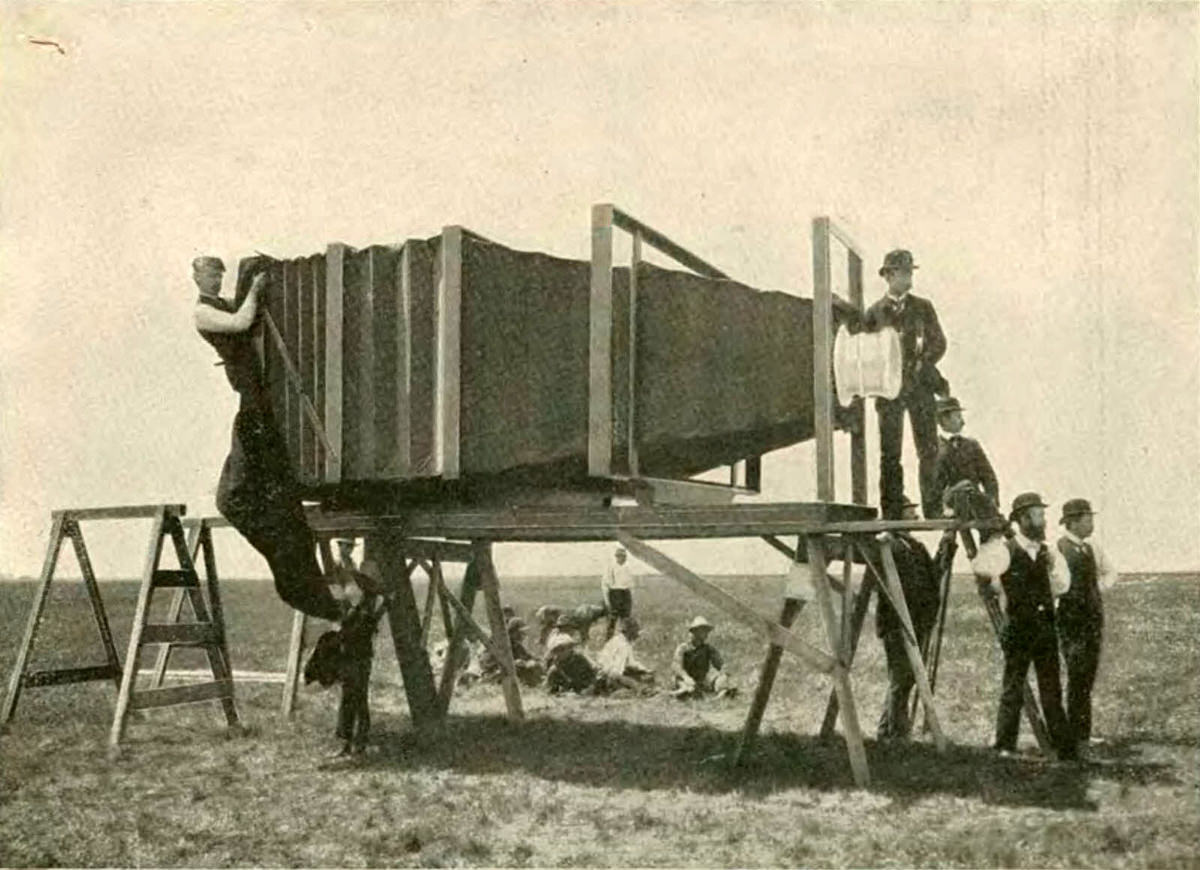
A massive bellows camera dominates an open field, perched on a timber platform like a small building turned on its side. Several men in hats and work clothes cluster around it—one climbing at the rear, another stationed near the front standard—suggesting a coordinated routine rather than a casual snapshot. The title, “Shooting the 2.5-minute exposure,” hints at the patience and precision required when the camera itself was as much a machine as an instrument of art.
Long exposure photography demanded stillness from everyone involved, from the operator managing the lens and shutter to the assistants handling the heavy camera body and its supports. The scale of the apparatus points to large-format imaging, where a bigger negative meant sharper detail, but also meant more weight, more setup time, and more chances for vibration to ruin the plate. Out in the bright, unobstructed landscape, the crew could take advantage of natural light while wrestling with the limits of early photographic chemistry.
Seen today, the scene reads like a snapshot of invention in practice: woodworking, optics, and teamwork converging to make an image that could not be rushed. The men standing by with folded cloths and attentive postures evoke the familiar dark-cloth ritual, shielding the lens and focusing screen from glare while the world waited for those minutes to pass. For anyone interested in the history of cameras, early outdoor photography, and the engineering behind long exposures, this photograph offers a vivid reminder that progress often arrived on sturdy legs and in measured time.