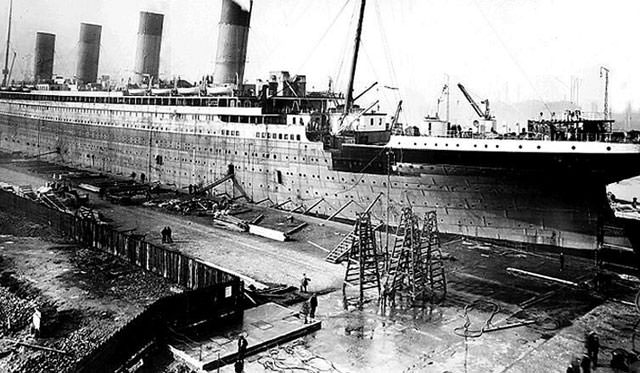
Rising above a busy shipyard, the Titanic’s hull dominates the frame, its long black flank lined with rows of portholes and scaffolded platforms that hint at the scale of labor still underway. Four great funnels tower over the superstructure, while cranes and rigging cluster along the deck, turning the waterfront into a forest of industrial silhouettes. In the foreground, workers and equipment appear small against the ship’s immense mass, underscoring why the liner’s construction became a symbol of early 20th-century engineering ambition.
Steel plates, riveted seams, and temporary wooden staging reveal how monumental passenger ships were assembled piece by piece, relying on precision as much as brute force. The yard itself looks like an outdoor workshop—mud, timber, ladders, and tools laid out in the open—where new manufacturing methods and large-scale organization made “modern” feel tangible. For readers searching the story of Titanic construction, this kind of scene is the missing chapter between blueprint and launch: a snapshot of invention applied at full scale.
Public fascination grew from sights like this, where technology and luxury promised a new era of ocean travel and helped build the legend of an “unsinkable” ship. Even without focusing on a single inventor or exact moment, the photograph speaks to the era’s confidence in progress—an optimism expressed through size, speed, and mechanical sophistication. As part of a WordPress post on Titanic innovations and rise to fame, it offers a grounded, human view of the ship before it became a global story.