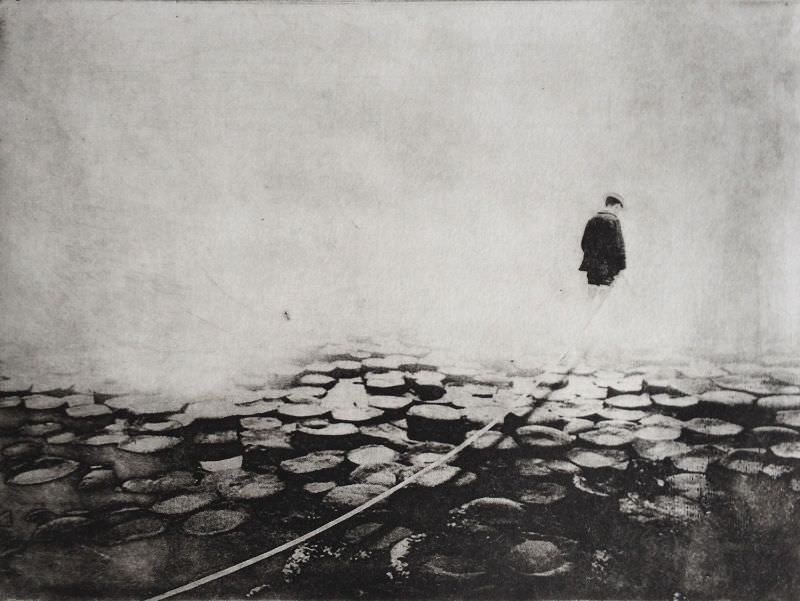
Against a vast, pale sky, a lone figure stands near the edge of a field of broken ice, small but sharply outlined in the open space. The title, “The Ropes No.2,” draws your eye to the long line cutting across the foreground—an anchored rope that leads outward into the haze, suggesting both direction and danger. Dark, irregular floes pile together like shattered stone, turning the surface into a restless mosaic of hard edges and thin seams.
The scene feels less like simple documentation and more like an artwork built from contrast: heavy blacks in the ice, soft whites in the air, and the quiet punctuation of a person at the horizon. That rope is the photograph’s grammar, a visual sentence that starts at our feet and ends at uncertainty, hinting at work, rescue, or careful navigation over unstable ground. With no readable signage or clear landmarks, the setting remains anonymous, which only heightens the universal sense of exposure and endurance.
As a historical photo for WordPress, this piece offers strong storytelling potential for themes such as maritime life, winter landscapes, and the material culture of safety and labor. Search-friendly details—rope line, ice floes, solitary figure, stark monochrome composition—make it easy to place within collections of early photography and environmental imagery. “The Ropes No.2” lingers because it balances human presence with overwhelming space, letting a single line and a single person hold the entire frame together.