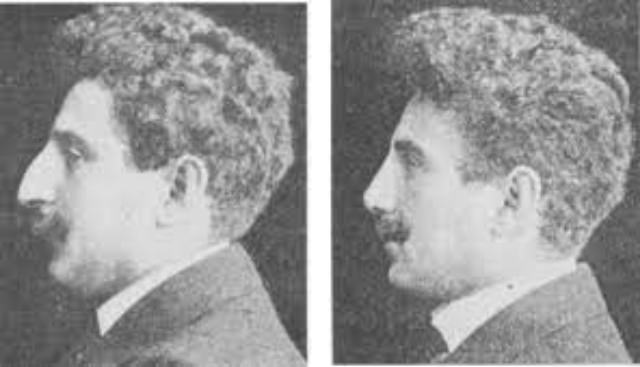
Side-by-side profile views of the same man invite a before-and-after reading that was becoming increasingly common in the 1920s and 1930s, when cosmetic surgery began to move from medical journals into popular conversation. The paired portraits focus tightly on the nose and jawline, using the clarity of a strict profile to make even subtle alterations easy to compare. Cropped hair, a neat moustache, and formal attire anchor the subject in the interwar style world that helped define what “modern” features were supposed to look like.
In one panel the nose appears more prominent and angular; in the other, the bridge and tip look refined, suggesting the kind of reshaping associated with early rhinoplasty. These images echo the era’s reliance on photographic proof, a persuasive tool for surgeons and a compelling promise for clients: transformation rendered measurable, almost scientific. The stark background and clinical framing also hint at the overlap between fashion culture and medical marketing, where personal appearance could be treated as both identity and project.
Rhinoplasty in this period sat at a crossroads of changing beauty standards, new consumer confidence, and the growing belief that modern techniques could remake the self. The photo’s simple composition—two nearly identical profiles divided by a narrow border—turns a private decision into a public narrative of improvement, perfectly suited to magazines and promotional materials. As a historical artifact, it speaks to how the desire for a “better” nose was shaped not only by medicine, but by the aesthetics and social pressures of the early twentieth century.